
OPINION: Breaking the Deadlock over Rohingya Repatriation Before Another Generation Is Lost
Nine years after the mass expulsion of the Rohingya from Myanmar, the word ‘repatriation’ has become almost ritualistic. Bangladesh demands it, Myanmar periodically promises it. China offers to mediate it, while the UN calls for conditions that would make repatriation safe and voluntary.
And yet the Rohingya refugees remain in Bangladesh.
This is not simply a failure of diplomacy. It is the consequence of a deeper political contradiction: the international community continues to speak about the return of the Rohingya while failing to create the political, legal, and security conditions in Myanmar that would make the return possible.
The latest developments make that contradiction painfully clear. On August 17, 2026, Myanmar’s military-backed authorities confirmed that nearly 309,000 Rohingya refugees in Bangladesh had been verified as former residents of Rakhine State, but said repatriation would have to wait until security conditions improved. There was not a word about the rest of the nearly 1.2 million refugees and their future.
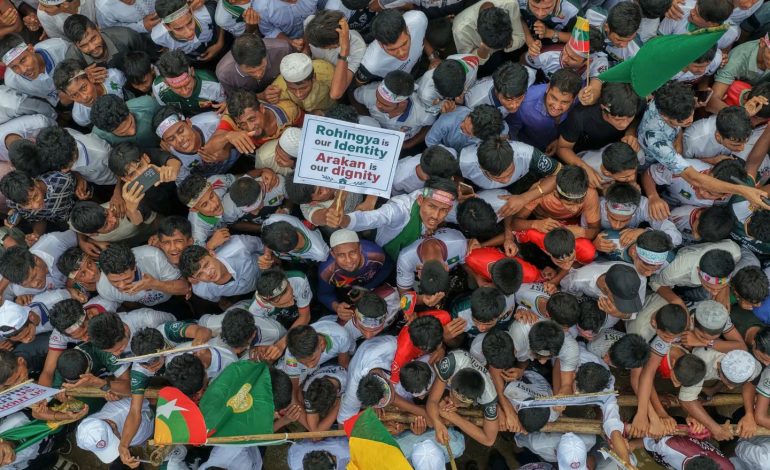
Just days later, tens of thousands of Rohingya refugees gathered in Bangladesh’s camps to demand a safe return to Myanmar, while international concern over deteriorating conditions in Rakhine intensified.
The message is unmistakable: the Rohingya refugees want to go home, but they cannot safely go home to the Myanmar that exists today. That distinction must become the starting point for a new diplomatic strategy.
The paradox of return
1.2 million Rohingya refugees now live in Bangladesh, most in the sprawling settlements of Cox’s Bazar, the southeastern district of the country bordering on Myanmar. More than 750,000 fled Myanmar following Myanmar’s brutal 2017 military campaign in Rakhine State, joining earlier waves of displacement.
Bangladesh has shouldered an extraordinary burden. But humanitarian generosity cannot become an indefinite substitute for a political solution. The camps were never intended to become permanent cities.
Refugees face restrictions on movement and livelihoods, inadequate shelter, insecurity, and dependence on humanitarian assistance. UNHCR’s 2025 Annual Results Report for Bangladesh documents continuing security concerns inside the camps, while noting that voluntary, dignified, safe, and sustainable repatriation remains the preferred solution when conditions allow. The international funding situation has also become increasingly precarious. The consequences are becoming visible in the most tragic way: refugees are increasingly risking their lives at sea.
In 2025, nearly 900 Rohingya died or disappeared while attempting maritime journeys, according to the UN. More than 6,500 attempted the dangerous crossings in the Bay of Bengal and the Andaman Sea to escape misery.
That is not merely a refugee problem. It is evidence of a policy failure.
When people are willing to board overcrowded and unsafe boats rather than remain indefinitely in camps, the world should understand what they are saying: a life without rights, prospects, or political horizon eventually becomes intolerable.
Yet the answer cannot be to push them back across the border simply because Bangladesh’s humanitarian capacity is under enormous strain. Repatriation without rights would not be a solution but a prelude to another displacement waiting to happen.
Myanmar is not ready to welcome the refugees
The political and security environment in Rakhine is the central obstacle to repatriation. The problem has become even more complicated since the Arakan Army emerged as the dominant armed group across large areas of Rakhine State.
A Reuters report on August 25, 2026, summarizing a new UN human rights report said conditions in Myanmar had deteriorated to a new low. The report documented killings, torture, forced labor, arbitrary detention, and displacement affecting Rohingya communities, with abuses attributed to both Myanmar’s military and the Arakan Army.
The question is no longer simply, “When will Myanmar take the Rohingya back?” It is rather: who controls the territory and who guarantees security? Who protects citizenship rights and who will be held accountable if returnees are attacked?
This is exactly why Bangladesh’s diplomatic choices have become so difficult. Dhaka has traditionally dealt with Myanmar’s central authorities because Myanmar is the state to which the refugees are expected to return. But the reality on the ground is changing faster than the diplomatic architecture.
Any serious repatriation plan must therefore address the de facto power structure in Rakhine as well as the authorities in Naypyidaw. This does not mean legitimizing every action of the Arakan Army. Nor does it mean abandoning Myanmar’s responsibility for the Rohingya crisis. It simply means recognizing political reality.
The citizenship question cannot be buried
At the heart of the crisis lies an issue that diplomatic negotiations have repeatedly tried to manage around: Rohingya identity and citizenship. Myanmar’s refusal to fully recognize the Rohingya as a legitimate ethnic community has always been more than a matter of terminology. It is central to their exclusion from citizenship, political participation, freedom of movement, and equal protection under the law.
A repatriation program that brings people physically back while leaving this legal exclusion intact would reproduce the architecture of persecution.
The Rohingya are not simply asking for transportation from Bangladesh to Myanmar. They are asking to return home. That means restoring something far more fundamental than residence: rights, dignity, security, freedom of movement, and a genuine prospect of citizenship.
This is why the current offers from Myanmar must be treated cautiously. A partial return of a few hundred thousand people may create an attractive diplomatic headline. But unless it forms part of a credible pathway for the entire displaced population, it risks institutionalizing a two-tier system in which Myanmar chooses whom to accept and leaves the rest in permanent exile.
That cannot be called a durable solution.
Dhaka needs to move beyond the politics of waiting
Bangladesh is right about one fundamental point: It cannot be expected to host the Rohingya indefinitely.
But Bangladesh’s diplomatic strategy now needs to evolve from repeatedly demanding repatriation toward engineering the conditions under which safe repatriation becomes unavoidable for Myanmar and its international partners.
For years, the diplomatic process has revolved around bilateral negotiations, verification lists, and pilot schemes. Yet Myanmar’s political and territorial transformation has made the old model increasingly obsolete.
The International Crisis Group has argued that Bangladesh needs to reset its approach to the Rohingya crisis rather than continue relying primarily on the existing diplomatic framework. That reset should have four elements.
First, Bangladesh should insist that no return is genuinely voluntary unless refugees have an informed choice. The UN position remains clear: refugees have a right to return to their country, but no one should be forced to return to conditions that are unsafe or unsustainable.
Second, Dhaka should internationalize responsibility. The Rohingya crisis should not remain framed as a bilateral Bangladesh-Myanmar dispute. It is an international protection crisis created by mass atrocities and prolonged by geopolitical paralysis.
Third, Bangladesh should engage all relevant actors in Rakhine while making Rohingya rights non-negotiable. Engagement with the Arakan Army, Myanmar’s authorities, ASEAN, China, the UN, and Western governments should not be mutually exclusive.
Fourth, Dhaka must prepare for the possibility that repatriation will take longer than anyone wishes. That means securing predictable international financing, education, livelihoods, and protection in the camps, not because Bangladesh accepts permanent settlement but because humanitarian desperation weakens the refugees’ ability to negotiate their own future.
The international amnesia
The greatest danger now is that the refugee issue is becoming a normal issue.
The Rohingya crisis has been displaced from the global headlines by wars elsewhere, geopolitical rivalry, and domestic political crises. Donor fatigue is setting in. The humanitarian response remains badly underfunded: the 2026 Joint Response Plan requires hundreds of millions of dollars to support the refugees.
But humanitarian fatigue should not become moral fatigue. The international community helped create the architecture of the current impasse by treating Myanmar’s 2017 atrocities as a humanitarian emergency without generating sufficient political consequences for those responsible. Now the world faces a second failure: allowing the consequences of that crime to become permanent.
The International Court of Justice’s genocide proceedings matter. International accountability matters. Sanctions and diplomatic pressure matter. But accountability and repatriation must be connected to the same political objective: ensuring that Rohingya people can return as rights-bearing citizens rather than as tolerated minorities.
Otherwise, the world risks committing a peculiar injustice. The perpetrators of displacement remain politically entrenched while the displaced are asked to demonstrate “readiness” to return.
The Rohingya must have their voice
Perhaps the most fundamental flaw in the repatriation process is that it has too often been negotiated about the Rohingya rather than with them. Refugees are not passive cargo to be transferred between states. They are political actors with legitimate demands.
If Rohingya communities say they will return only when their safety, citizenship, property rights, and dignity are protected, diplomats should not dismiss this as an obstacle to repatriation. They should recognize it as the minimum foundation of sustainable repatriation.
A return that refugees themselves reject is unlikely to last. Indeed, the thousands who gathered in Cox’s Bazar on August 25, 2026, demonstrated that the Rohingya’s aspiration is not simply to remain in Bangladesh. They want to return home – but to return safely and with rights.
A final warning
The Rohingya crisis is approaching a dangerous crossroads. The longer the deadlock continues, the more entrenched the camps become, and the more Bangladesh’s burden grows. The humanitarian consequences are already visible in the deadly maritime exodus.
But the answer is not indefinite humanitarian containment. The only viable path is a safe, voluntary, dignified, and rights-based return backed by international guarantees and political accountability.
Bangladesh should continue insisting on repatriation, but it should stop allowing Myanmar to define what repatriation means. Return must mean more than crossing the Naf River. It must mean reclaiming one’s home or receiving genuine restitution. It must mean freedom of movement, education for children, access to work, and security from hostile armed groups. And above all, it must mean the right to exist as a human being with equal rights in one’s own country.
Nine years after the tragic Rohingya exodus, the world has run out of excuses for treating this crisis as temporary. The Rohingya cannot be expected to wait forever in Bangladesh. But neither can they be sent back into a political and security landscape that is extremely risky for their survival.
The real choice is therefore not between repatriation and no repatriation. It is between a repatriation that merely moves bodies across a border and a repatriation that restores a people to their home, their rights, and their future, before another generation is lost.



The latest news in your social feeds
Subscribe to our social media platforms to stay tuned