
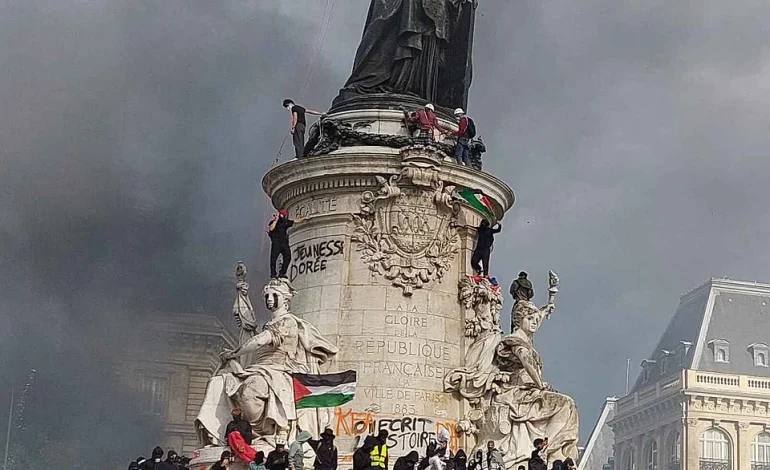

What started in late September with teenagers complaining about broken radiators and missing teachers spiraled, within a month, into the largest and most violent wave of unrest France has seen in years. Here’s how a student movement about classroom conditions put half a million people on the streets of French cities.
Lycée Antoine-de-Saint-Exupéry in Créteil isn’t a famous school. At least it wasn’t before September 21, 2026, when students there staged a protest over unfilled teaching positions and deteriorating conditions, four days after a teachers’ strike at the same school on September 17. Within a week, the protest had spread across the Paris region. Within a month, it had become a national crisis. So how did all go down?
September 28–30 saw the scale jump sharply. Hundreds of schools were affected by that point, and clashes with police, arrests, and reports of injuries intensified the confrontation between demonstrators and the state in a way that hadn’t been visible in the movement’s first week. By October 1, Reuters reported a genuinely alarming incident – attackers dousing a teacher with petrol amid the escalating unrest.
October 1–2 brought university students into a movement that had, until then, been almost entirely a secondary-school phenomenon. More than 1,000 secondary schools were reported affected by this point, and authorities had begun ordering remote classes or outright closures at some locations rather than attempting to keep buildings open amid the blockades.
October 8 brought continued demonstrations nationwide, with student and university organizations announcing yet another coordinated mobilization. October 13, the fifth official national day of action, drew substantially larger crowds than its predecessors, with student organizations continuing to press the same core demands around school conditions and resources that had started the whole thing.
Then came October 17, the day everything converged. Students, trade unions, and Yellow Vest supporters joined together across roughly 110 separate marches nationwide. The Interior Ministry put the total turnout at 550,000 participants; organizers claimed closer to 800,000. Most of the day’s demonstrations passed peacefully. But in a number of cities, things went badly wrong – clashes, looting, arson, and serious damage to public buildings, including Limoges city hall, which became one of the most widely circulated images of the day’s violence. Authorities reported over a thousand arrests nationwide (the number later grew to 2700) and extensive injuries among police officers who’d been deployed to manage the day’s events. President Emmanuel Macron condemned the violence directly and publicly, while Prime Minister Sébastien Lecornu announced targeted curfews in some of the worst-affected areas.
Organizers had announced a second nationwide mobilization for October 24, framed explicitly around demands for dignity, the right to assemble freely, and accountability over the police’s handling of the protests. As of October 22, that’s a planned action rather than a confirmed event; whether it matches or exceeds October 17’s scale remains to be seen.
Considering the shock value of protest imagery, it’s worth being precise about sequence here: the riots were an escalation within a much broader protest movement that had been building for a month, not the spark that started it. The underlying grievances about schools and the cost of living came first. Our own early assessment of the movement argued the protest wave was fundamentally bigger than the riots that dominated headlines.
What lies behind the protests? The grievances students raised were concrete: teacher shortages, overcrowded classrooms, buildings falling apart, inadequate facilities, and insufficient support staff. None of it was new – French teachers had been raising versions of these complaints for years without much traction. What was new was that students themselves picked up the fight, and social media let the protest spread school to school far faster than any previous wave of education unrest. Similar grievances had already triggered school blockades in French Guiana and Mayotte – French territories where underfunding of education runs even deeper than on the mainland.
Running in parallel, and initially on a completely separate track, was a fuel-price protest movement that began on September 15 – driven by diesel prices climbing toward record highs amid disruptions to energy supplies tied to the Iran war and instability in Yemen. By mid-September, diesel was running at €2.37 per liter (over $10 a gallon), close to its all-time peak. Fishermen blocked the ports of Nice and Sète on September 17, the same week the student movement was gathering steam, and other protesters blocked roads leading to fuel depots.
The French public had three distinct grievances, running on parallel tracks. Economic insecurity from rising fuel costs, inflation, rent, and the general grind of household expenses had been building pressure for years. Public spending cuts added fuel directly: anger over a proposed €61 billion ($68.4 billion) in government spending reductions, layered on top of complaints about chronically underfunded schools and public services that had already been stretched thin for a decade. Political dissatisfaction tied the whole thing together – frustration with Macron’s government specifically and demands for greater social equality and accountability.

The latest news in your social feeds
Subscribe to our social media platforms to stay tuned