
EXCLUSIVE: France’s Protest Crisis Has Entered Second Phase
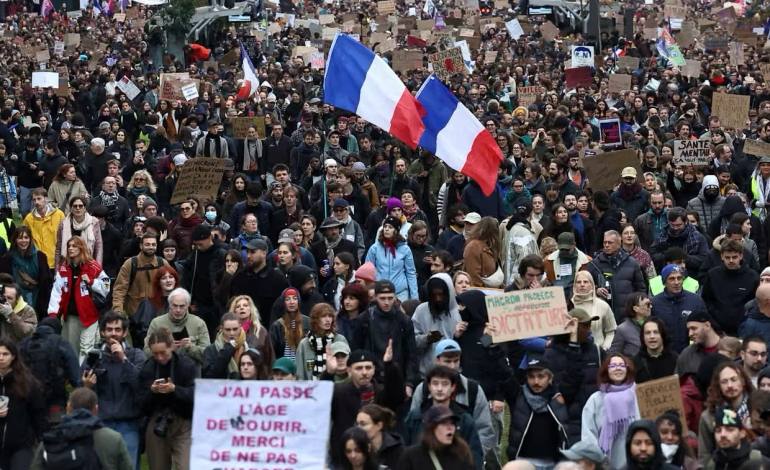

A week after France’s largest demonstrations in years descended into looting, arson and clashes in several cities, hundreds of thousands of people went back into the streets. That fact may be more important than the violence that again appeared around the edges of the marches.
France’s Interior Ministry counted about 410,000 demonstrators nationwide on October 24, while the CGT trade union put turnout closer to 800,000. The government deployed roughly 70,000 police officers and gendarmes in an effort to prevent a repeat of the widespread destruction seen on October 17. Authorities reported 1,314 arrests, but the marches themselves were largely peaceful before confrontations erupted later in Paris, Marseille and several other cities.
The movement has not disappeared. Protest groups and unions are already calling for another round of demonstrations on October 31 and a nationwide strike on November 5. Prime Minister Sébastien Lecornu, meanwhile, is meeting high-school representatives as the government searches for what it describes as concrete answers to the grievances that began the crisis.
France has therefore moved beyond the question of whether September’s student protests would survive.
They have.
The harder question now is what kind of crisis they have become.
Two France-based political sociologists interviewed by the Wyoming Star offer different but complementary answers. Didier Le Saout, Associate Professor of Political Sociology and a researcher at Université Paris 8 Vincennes-Saint-Denis, focuses on the mechanics of escalation: how school blockades created direct confrontations, how broader social grievances attached themselves to the student movement, and how organized political violence and opportunistic looting complicated the state’s response.
Dr. Emmanuel-Pierre Guittet, an associate researcher at Sciences Po’s Centre for International Studies and other European research centers, sees a deeper danger: a political system gradually losing its ability to manage conflict through persuasion, negotiation and compromise, and increasingly falling back on coercion instead.
Taken together, their arguments point toward a central difficulty for France.
The state may simultaneously be policing some forms of violence too weakly and peaceful political dissent too aggressively.
And solving one problem without recognizing the other could make the crisis worse.
The confrontation began with high-school students, not rioters.
As the Wyoming Star previously reported, the first mobilizations grew out of complaints about missing teachers, staff shortages, deteriorating buildings and wider concerns about the quality and accessibility of education. By early October, protests had spread through more than 1,000 secondary schools, with university students subsequently joining them.
Didier Le Saout, Associate Professor of Political Sociology and researcher at the University of Paris 8 Vincennes Saint-Denis, argues that the tactics students chose were important in determining what happened next.
“The movement, which began on September 21 at a high school in Créteil, in the Paris suburbs, started as a protest against the shortage of school staff,” he told the Wyoming Star. “From the very first actions, blocking school entrances emerged as the preferred method of protest.”
That changed the physical relationship between protesters and police.
“This face-to-face standoff right at the school entrances led to numerous clashes between high school students and the police,” Le Saout added.
The confrontations did not remain a dispute about schools for long.
“The high school students’ demands were quickly joined by more traditional social demands,” Le Saout said. “Bringing together young people, workers, retirees, and families, the protest expanded to include criticism of the high cost of living, with demands for higher wages and increased funding for education and public services.”
That expansion explains why the movement proved capable of surviving after October 17. The coalition is not ideologically uniform. Students demanding better schools, trade unionists seeking higher wages, Yellow Vest activists angry over living costs and other demonstrators dissatisfied with the Macron government do not necessarily want the same thing.
What they do share is a sense that existing political channels have not produced sufficient answers.
Guittet describes the original grievances as “entirely legitimate.”
“The immediate grievances are entirely legitimate: deteriorating school conditions, shortages of staff and equipment, and the wider decline in public services,” he told the Wyoming Star.
He also cautioned against treating the most dramatic images as representative of the movement as a whole.
“These concerns should not be obscured by the focus on violent confrontations. The overwhelming majority of demonstrations have been peaceful. The images that dominate news coverage do not necessarily reflect the movement as a whole,” Guittet said.
October 24 offered some evidence for that distinction.
Hundreds of thousands again marched even after a week dominated by images of burning buildings, smashed storefronts and clashes with police. Large union-organized processions remained largely peaceful, even as violence broke out later in some cities.
But separating peaceful protest from political violence is not simply a media problem. It has become an operational problem for the French state.
Le Saout draws a sharp distinction between the organized social movement and groups that use demonstrations for different purposes.
He noted that the union march in Paris on October 17 took place separately and “with no reports of looting along the march route.”
“However, urban violence has compounded this climate of tension, shifting the action to other neighborhoods,” he said.
He argues that elements of the ultra-left have deliberately tried to attach violent tactics to the broader movement.
“At the same time, the ultra-left (autonomists and Antifa) has sought to undermine the peaceful nature of the social movement’s organizations in order to legitimize violence, which they present as the only means of achieving social demands, with the ultimate goal of destroying the state.”
That is Le Saout’s interpretation of the radical groups involved, rather than a description that can be applied to the protest coalition as a whole.
His account of October 17 also complicates the idea that France’s principal policing problem was simply excessive force.
In several cities, he argues, police were not sufficiently prepared for the scale and geography of the violence.
“To deal with these outbreaks of violence, law enforcement was mobilized in insufficient numbers,” Le Saout said.
He cited reporting that intelligence services had substantially underestimated turnout and that Paris police received fewer riot-police and gendarmerie reinforcements than requested.
The government itself subsequently acknowledged failures in the October 17 response and promised a far larger security operation for the following weekend. On October 24, some 70,000 officers were deployed nationwide. The result was not an absence of violence, but considerably less widespread looting and destruction than one week earlier.
That suggests that targeted policing can matter.
But Guittet warns that restoring physical order and restoring political legitimacy are not the same task.
“What concerns me most is the brutalisation of political life,” he said. “I do not mean simply a drift towards the far right. I mean the erosion of politics as a space for reason, argument and compromise. The state has a legitimate responsibility to protect people and enforce the law. But restoring order is not the same as restoring legitimacy.”
That distinction may now be the central challenge facing the Macron government.
Authorities have imposed curfews, restricted demonstrations and, in some cities, prohibited gatherings altogether. Before the October 24 mobilization, more than 100 French municipalities were subject to some form of curfew or protest restriction. Lyon, Marseille and other cities imposed particularly extensive measures after the previous weekend’s unrest.
Those measures can reduce immediate opportunities for disorder. They can also constrain people who have committed no violence.
“The problem is not that conflict exists; conflict is intrinsic to democratic politics,” Guittet said. “It is that we seem increasingly unable to deal with it without resorting to force. When legitimate social grievances are treated primarily as security problems, coercive responses can deepen the resentment they are intended to contain.”
Le Saout approaches the same dilemma from another direction.
He argues that arrests alone cannot resolve urban violence because the population participating in it is not fixed.
“Arrests alone are not enough to curb the cycle of violence.”
In his analysis, organized radical activists and opportunistic looters operate according to different motivations. Detaining one group of participants on one evening does not necessarily prevent new participants from appearing during the next confrontation.
“Consequently, the arrest of one-day looters is immediately offset by the arrival of new rioters in the days that follow,” he said.
The implication of both arguments is uncomfortable.
More police may be necessary to prevent businesses from being looted or public buildings from being burned. But more police cannot repair schools, increase wages, lower living costs or restore confidence that political institutions are listening.
And those underlying problems are becoming harder to solve precisely as pressure for solutions increases.
France’s public finances are severely constrained. Official data show public debt reached €3.5955 trillion in the second quarter of 2026, equivalent to 119% of GDP. The country recorded a public deficit of 5.1% of GDP in 2025.
Guittet argues that this fiscal reality cannot simply be ignored.
“France resembles a family that has accumulated unsustainable debts without ever being properly told that it was living beyond its means – and, worse still, one that has repeatedly been handed new credit cards,” he said.
But his argument is not that budget constraints automatically justify cuts.
“The lesson is not that austerity is inevitable or desirable in every form. It is that difficult choices cannot be postponed indefinitely without making the eventual reckoning more painful. France needs an honest debate about what should be protected, what can realistically be afforded, and how the costs should be shared fairly,” Guittet said.
That places the government in a difficult position.
Students and unions are demanding greater investment in education and public services. Workers are confronting living-cost pressure. At the same time, fiscal constraints limit the government’s ability to answer every grievance with another large spending package.
Le Saout similarly sees little room for an easy settlement.
“Emmanuel Macron and his government are staying the course in the political center, prioritizing negotiations with social partners to develop jointly agreed-upon measures. However, the scope of these political compromises is limited by the strict financial constraints imposed by the level of public debt in France,” he said.
But financial constraints do not eliminate political choices.
Guittet argues that any credible settlement has to begin with concrete, verifiable responses to the original educational demands.
“The first step is to take the educational grievances seriously in their own right: establish the extent of staffing and material shortages, identify concrete priorities and involve students, teachers and school communities in deciding what can realistically be done,” he explained.
More broadly, he argues that citizens must be allowed to see and influence the tradeoffs.
“Difficult choices are unavoidable, but they cannot simply be presented as technical necessities, beyond political debate. The challenge is to reconcile fiscal responsibility with social justice, rather than treating them as mutually exclusive.”
Whether France can do that may also determine what the crisis means politically.
Le Saout says October 17 changed the agenda. Before the riots, much of the debate centered on public services, living standards and the government’s fiscal choices. After the destruction, public order moved rapidly to the foreground.
He describes parties on both sides as adapting accordingly.
“It is in no one’s interest for the unrest to drag on,” he said. “The radical left, embodied by La France insoumise (LFI), is maintaining its strategy of social conflict, while the National Rally (RN) is finding new justifications to toughen its security agenda”
Guittet is similarly concerned about a political debate increasingly organized around coercion, although he cautions against treating any electoral outcome as predetermined.
“The far right could benefit if public debate becomes increasingly dominated by insecurity, authority and demands for order. Yet the outcome is not predetermined.”
His larger concern is that voters could be offered competing versions of tougher authority without a comparable competition over how to repair the underlying institutions.
“The danger is that the election offers competing degrees of coercion rather than genuinely different visions of the future.”
France is therefore entering a different stage of its protest crisis.
The first stage asked whether an uprising that began outside high-school gates could spread.
It did.
The second asked whether the violence of October 17 would destroy the broader movement’s ability to mobilize.
October 24 showed that it did not. Hundreds of thousands returned to the streets, and further demonstrations are already being organized.
The next stage may be more difficult because it cannot be solved by either side proving a simple point.
The government is right that looting, arson and attacks on people or public institutions cannot be accepted as ordinary democratic protest.
The peaceful demonstrators are equally entitled to insist that the existence of rioters does not erase grievances over schools, wages, living costs and public services.
This is where Le Saout’s and Guittet’s analyses ultimately meet.
France needs a state capable of distinguishing between those things.
It needs enough authority to stop people who burn buildings and loot stores without treating hundreds of thousands of peaceful demonstrators as a single security threat. And it needs enough political capacity to answer social grievances without pretending that deploying more police constitutes an answer to why people entered the streets in the first place.
Guittet describes the alternative as a vicious circle.
“The danger is a vicious circle: the less credible institutions become, the more they rely on coercion; the more coercion becomes routine, the less legitimate those institutions appear,” he noted.
France, he stresses, is not destined for political breakdown.
“France is not necessarily on an inexorable path towards authoritarianism. But it is struggling to preserve the conditions under which democratic conflict can be managed through reason, negotiation and compromise. When coercion becomes a substitute for politics, the state may secure compliance in the short term while deepening the crisis that made coercion necessary in the first place.”
With another demonstration planned for October 31 and a nationwide strike call for November 5, that distinction is no longer theoretical. France has shown that it can put 70,000 police officers on the streets. The harder test is whether it can put politics back there as well.

The latest news in your social feeds
Subscribe to our social media platforms to stay tuned