
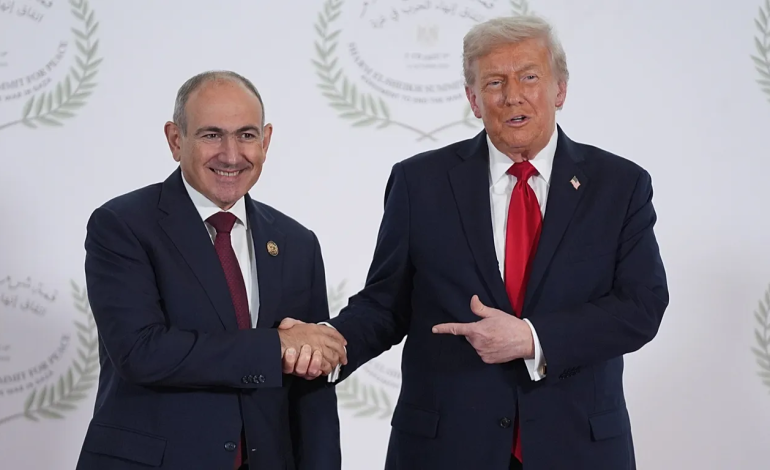

It’s been two months since Armenian voters handed Nikol Pashinyan and his Civil Contract party a mandate to dictate the state’s foreign and domestic policy. Armenia, landlocked and surrounded by historical enemies, is moving to leave Russia’s security orbit while Iran burns to its south and Azerbaijan demands constitutional concessions to its east. This direction has been building since the catastrophic loss of Nagorno-Karabakh in 2023. What comes next will determine whether Armenia finds a new anchor in the West or ends up as a failed buffer.
The current alignment first showed up as Armenian aspirations for the EU and greatly accelerated with remarkable sequence of American diplomatic achievements across 2025 and 2026. On August 8, 2025, US brokered a joint Armenia-Azerbaijan declaration that stopped well short of a full peace treaty but established a framework for resolving the outstanding territorial and communications disputes. It created a bilateral commission, opened the door to transport corridors, and – critically – gave Washington a permanent seat at a table that had previously belonged to Moscow. The full text outlined a pathway from ceasefire to normalized relations, but left the hardest questions – border delimitation, constitutional amendments, the fate of Armenian-held territories – for later. That later is now arriving.
The American push didn’t stop with the declaration. In August 2025, the two sides initialed a 15-point peace agreement text that Armenia and Azerbaijan both published. It included provisions for mutual recognition of territorial integrity, no use of force, and the opening of regional communications. But the more consequential initiative was TRIPP – the Trump Route for International Peace and Prosperity. First publicly outlined in late August 2025, the corridor aimed to rewire the South Caucasus by giving Azerbaijan a 27-mile access route to its Nakhchivan exclave through Armenian Syunik province thus connecting Azerbaijan, Armenia, and Turkey through rail, road, and digital infrastructure, bypassing both Russia and Iran. Iranian officials immediately demanded clarity from Yerevan, sensing that a US-backed route through Armenian territory would sever Tehran’s direct land link to the South Caucasus and expose its vulnerable northern flank.
February 2026 brought Vice President JD Vance to Yerevan and Baku, the first time a sitting US vice president had visited Armenia. Vance announced nuclear cooperation with Armenia – a stunning departure for a country whose energy sector remains deeply tied to Russia – and talked up energy security and trade routes. The Crisis Group called the visit a “reaffirmation of the US push to end the Armenia-Azerbaijan conflict,” while Radio Free Europe noted the administration’s willingness to discuss genocide recognition as part of the package.
Then the Iran war exploded. Operation Epic Fury began on February 28, 2026, and within weeks the conflict had reached Armenia’s southern border. In our March, April, and May analyses warned that the war could “ruin US strategic aspirations in the South Caucasus” and leave Armenia as “collateral damage.” But the war also gave Washington a powerful new reason to invest in Armenia as a stabilizing corridor. In May 2026, the two countries signed the TRIPP Framework Agreement, codifying the strategic cooperation around the corridor and granting American-linked development entities 74% stake in the project.
By the time the June 7 election arrived, Pashinyan had already decided that the West was Armenia’s future. His Civil Contract party ran on an explicit program of Western integration: EU membership application supported by the May 2026 Connectivity Partnership – the main achievement of the EU-Armenia summit in Yerevan, continued implementation of TRIPP, a peace treaty with Azerbaijan, and constitutional changes that would remove any legal ambiguity about Nagorno-Karabakh. The fragmented opposition failed to offer a coherent alternative. The result was a landslide. OSCE observers called the election well-administered and competitive, but the outcome was never in doubt. Pashinyan won because he was the only politician with a story – even if that story required Armenians to accept the permanent loss of Artsakh and a constitutional rewrite that many in the diaspora see as betrayal.
The broader context of Pashinyan’s Western pivot has been years in the making. Russia, Armenia’s traditional protector, failed to defend Nagorno-Karabakh during the 2020 war and again during Azerbaijan’s full seizure in September 2023. Pashinyan has systematically distanced Armenia from the Kremlin since: suspending participation in CSTO, questioning the value of the Russian military base at Gyumri, and pivoting toward Western institutions. The EU has become a partner of first resort, with a bilateral agenda that includes energy, governance reform, and, eventually, a path toward membership. The CACI analyst and other regional observers have described the shift as “strategic ambiguity” mixed with a determined search for new security anchors – ambiguous only in the sense that Armenia cannot afford to provoke Moscow outright while still dependent on Russian gas and rail links.
That ambiguity is becoming harder to maintain. Pashinyan has publicly blamed his EAEU colleagues – Russia, Belarus, Kazakhstan – for obstructing Armenia’s EU pivot. Armenia’s application to join the EU, while still in its early stages, has drawn warnings from Russian officials that economic ties will suffer. Yet Civil Contract’s victory has given Pashinyan the political capital to press ahead with the Western agenda without fearing an immediate electoral backlash.
That agenda now hinges on two things: TRIPP and Azerbaijan. The TRIPP Framework Agreement, signed in May, gave the project legal form, and the June election removed any doubt that Armenia would honor it. The corridor is the centerpiece of the Trump administration’s South Caucasus strategy – an east-west route that connects Central Asia and Azerbaijan to Turkey and Europe, bypassing both Russia and Iran while locking in the Armenian-Azerbaijani peace process. For Armenia, TRIPP offers economic integration with the West, but requires accepting a degree of American security influence in Syunik, the strip of land that Iranian officials consider their own backyard. The Iranian ambassador has already warned Yerevan that Tehran is watching the corridor closely, and any expansion of US military or intelligence presence along the border would be a red line. The war has not ended, and the South Caucasus remains a potential flashpoint.
Azerbaijan’s conditions for a final peace treaty remain the hardest obstacle. President Ilham Aliyev has made clear that no agreement will be signed until Armenia amends its constitution to remove any reference to Nagorno-Karabakh, a demand that Pashinyan has privately accepted but publicly struggled to sell. The constitution currently contains language that Azerbaijani officials say leaves the door open to future Armenian claims on the territory. Changing it requires a referendum, and a referendum requires a public that is still grieving the loss of Artsakh and deeply suspicious of the West’s willingness to protect Armenia from further Azerbaijani pressure. The opposition, weak as it is, will use any constitutional vote as a referendum on Pashinyan himself. Azerbaijan knows this, and it is pressing its advantage while the regional balance still tilts in Baku’s favor.
Two experts on Armenian geopolitics offered sharply different readings of what the election means for the next few years.
Prof. Barlow Der Mugrdechian, the Berberian Director of the Armenian Studies Program at California State University, Fresno, sees a decisive shift while Prof. Richard D. Kauzlarich, US Ambassador (ret.) to Azerbaijan (1994–1997) and to Bosnia and Herzegovina (1997–1999), Co-director of the Center for Energy Science and Policy (CESP) and Distinguished Visiting Professor at Schar School of Policy and Government of George Mason University, is more cautious about what the mandate can actually deliver, and Dr. Simon Saradzhyan, founding director of the Russia Matters Project at Harvard Kennedy School’s Belfer Center for Science and International Affairs, warns about the difficulty of Armenia’s balancing as well as the transactional approach to politics of Trump’s White House:
Wyoming Star: What does the Civil Contract’s victory mean for the direction of Armenia’s foreign policy over the next few years? Does Pashinyan now have a stronger mandate to pursue the country’s Western pivot?
Prof. Mugrdechian: Armenia is definitely moving towards the EU and the US in its foreign policy and economic ties. The recent elections solidified Pashinyan’s position, so yes, it gave him a mandate to move further from Russia and towards the West.
Amb. Kauzlarich: I’m not convinced that the elections will change the pro-West direction of Armenian foreign policy. They may make it less likely Armenia will turn pro-Russian.
Dr. Saradzhyan: Yes, it does give Pashinyan’s government a stronger mandate to pursue the country’s Western pivot. However, he won’t be executing this pivot in vacuum. Regional and external stakeholders include Russia and Iran that have no love lost for the collective West. I am not sure Turkey and Azerbaijan would be exactly welcoming such a pivot if it culminates in Armenia’s entry into EU. These stakeholders have resources to influence Armenia’s policies on such key issues, regardless of what supporters of PM Pashinyan in Armenia think of his vision for Armenia. Here’s a piece in which I described a similar challenge faced by Georgia.
Wyoming Star: What does the result mean for Armenia’s relations with the US and EU? Could the government now move faster on projects such as TRIPP and broader political and economic integration with the West?
Prof. Mugrdechian: Armenia has already signed several agreements with the EU to expand trade and eventually have a path to EU membership. They are also moving forward with TRIPP and Armenia is also looking for security guarantee from the West.
Amb. Kauzlarich: TRIPP is moving in a good direction, even rapidly. The elections will reinforce the strategic partnership with the US. The EU will demand fundamental economic and political reforms that will take time. The US is not making similar demands for closer relations.
Dr. Saradzhyan: There are too many variables still at play to forecast what it’d mean for TRIPP. EU welcomes Pashinyan’s pivot. Whether Trump would continue to welcome it will depend on whether it generates tangible financial, economic and political benefits for Trump’s America.
Wyoming Star: How could the election victory affect the Armenia-Azerbaijan peace process? Will Pashinyan be more willing to make difficult concessions, including constitutional changes, in order to finalize a peace agreement?
Prof. Mugrdechian: Pashinyan’s platform included making significant changes to move to a final peace treaty. The abandonment of Artsakh and the political prisoners held in Azerbaijan are one part of this. He also intends to remove sections of the Armenian constitution that reference Artsakh.
Amb. Kauzlarich: On the economic side, Azerbaijan is opening trade routes for Armenian energy and food imports that can lay the basis for normal relations. The great uncertainty lies in what Pashinyan does to address Azerbaijan’s demand for a constitutional change removing any ambiguity about the future of Nagorno-Karabakh. There will be no final peace agreement absent that change.
Wyoming Star: What will happen to Armenia’s relations with Iran, Türkiye, and other regional powers? Could Pashinyan’s renewed mandate allow Armenia to pursue a more diversified foreign policy rather than simply choosing between Moscow and the West?
Prof. Mugrdechian: Armenia’s relations with Iran will remain close. They have recently expanded agreements in energy and other sectors. Armenia is also trying to normalize relations with Türkiye, including opening borders and expanding trade opportunities. Armenia would like a more diversified foreign policy but Russia is opposed to this.
Amb. Kauzlarich: Like Azerbaijan and Georgia, Armenia will try to pursue a balanced foreign policy. It will tilt pro-Western, but Armenia cannot afford to antagonize either Russia or Iran. Türkiye is a different matter. Things have been moving in the right direction, but future progress depends on how much normalization Erdogan will pursue with Armenia without a final Azerbaijan-Armenia peace agreement.
Wyoming Star: Can Armenian domestic opposition hinder or undermine Pashinyan’s course? Which side is the Armenian diaspora – one of the key Armenian geopolitical instruments – on?
Prof. Mugrdechian: The opposition is politically weak and so cannot much hinder Pashinyan’s plans. They have not put forward a clear vision of an alternative to Pashinyan. The Armenian Diaspora has basically been neutralized by Pashinyan in that he does not want to listen to the views of the Diaspora.
Amb. Kauzlarich: Pashinyan must always be conscious of the domestic opposition over policies on the Armenian detainees in Azerbaijan, the demands of the Armenian refugees from Nagorno-Karabakh, and constitutional changes that give up Armenia’s claim to Nagorno-Karabakh. Each issue has different red lines that require careful balancing and impact Armenia’s foreign policy direction. The Armenian diaspora has been critical of Pashinyan’s moves toward normalization with Türkiye and Azerbaijan, especially regarding Armenian constitutional changes that Azerbaijan is demanding.
Dr. Saradzhyan: Any country leader should avoid keeping all eggs in one basket and Pashinyan is no exception.
The assessments converge on the essential dilemma. Pashinyan has a mandate, but that does not eliminate red lines. The domestic opposition is weak, but the detainees in Azerbaijan, the refugees from Artsakh, and the diaspora’s vocal criticism are all pressures that could explode if the constitutional changes are mishandled. The EU demands reforms that will take years, while the US offers strategic partnership without many conditions. Russia remains hostile to Armenia’s drift, but Moscow is too preoccupied with Ukraine to enforce its will. Iran needs Armenia as a friendly land bridge, and Türkiye is waiting to see whether Azerbaijan gets what it wants before opening the border.


The latest news in your social feeds
Subscribe to our social media platforms to stay tuned