
EXCLUSIVE The South Caucasus. Triumph of Trumpian Diplomacy.
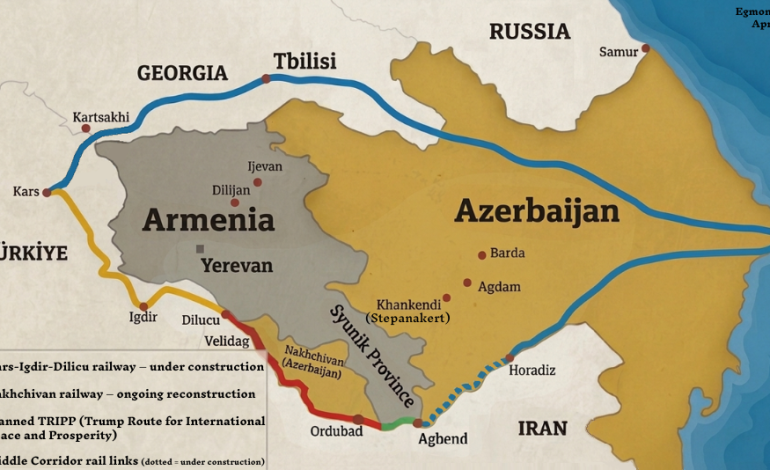

In the wreckage of America’s forever wars, the Trump administration has found an unlikely victory lap: the South Caucasus. As the Iran War grinds through its second round, sucking in US military power and shredding what was left of the regional security umbrella in the Middle East, a quieter diplomatic play has taken shape between the Black and Caspian Seas. The Trump Route for International Peace and Prosperity (TRIPP) is, by any honest measure, the only concrete strategic achievement of Trump 2.0. The corridor is not yet built. It rests on a shaky peace process to end a decades-old ethnic conflict. The whole thing might unravel before a single cargo container reaches the Turkish railhead. But after decades of treating the South Caucasus as a sideshow, Washington has moved from brokering handshakes to designing the furniture of a new regional order. And the centrepiece is a transportation artery that bypasses both Russia and Iran, locks in an Armenian-Azerbaijani peace nobody thought possible, and offers a tangible answer to a question that haunts Pentagon planners: what happens when the Strait of Hormuz goes dark?
In August 2025 the long-frozen conflict between Armenia and Azerbaijan, which flared shortly in the 2020 war and the 2023 lightning offensive, erasing the remnants of Nagorno-Karabakh, suddenly got a new development. In the Aug. 8 joint declaration, the two sides committed to a framework for peace. The breakthrough had been stitched together through months of White House prodding. Beyond the declaration, the name TRIPP first entered headlines. The project is the US attempt to kill a whole number of birds with one stone. Azerbaijan would get direct communication with its exclave Nakhchivan; Armenia will secure the peace deal it desperately needs after two major military defeats; and Türkiye, a long-term partner of Azerbaijan, will strengthen their economic ties as well as position itself on a new route linking China with Europe that is just being built.
Vice President JD Vance pushed the engagement further. In February 2026, he touched down in Yerevan and Baku for what was billed as a historic visit. It was more than ribbon-cutting. He announced nuclear energy cooperation with Armenia, talked up energy security, and made clear the United States was prepared to back its words with technical and financial commitments. The visit also served as an implicit guarantee to both capitals that Washington’s gaze wouldn’t wander the moment a crisis flared elsewhere. A guarantee soon to be tested.
By March 2026, the Iran war had erupted in full, reshaping every strategic calculation from the Gulf to the Caucasus. The widening US-Iran conflict suddenly made the South Caucasus even more precarious. Drone strikes in Azerbaijan and refugees from northern Iran made one assume the region can easily be pulled directly into the conflict. For a time, it seemed like the US might lose all its progress. By May, both Armenia and Azerbaijan were waiting on the US to finally return to the issue at hand.
The heart of the enterprise, TRIPP – the Trump Route for International Peace and Prosperity – finally morphed from a talking point into a legal instrument on 26 May 2026, when the United States and Armenia signed the TRIPP Framework Agreement. The document laid out a bilateral strategic cooperation mechanism to develop transport, digital, and energy connectivity along a corridor running from Central Asia, across the Caspian, through Azerbaijan and Armenia, onward to Türkiye and Europe. The text committed the parties to expedite permits, harmonise customs, and establish a joint investment vehicle – the TRIPP Enterprise Fund. Washington gained a permanent seat at a table with its 74% ownership stake that will be reduced in favor of Armenia now having the remaining 26% in 49 years’ time.
Back in Yerevan, the political ground shifted in ways that made the deal possible. Armenia held parliamentary elections on June 7, 2026, and Prime Minister Nikol Pashinyan’s Civil Contract party secured a renewed mandate, despite a deeply polarized electorate. The opposition, still reeling from the loss of Karabakh and from Pashinyan’s relentless consolidation of power, was, as analysts put it, “not prepared to win.“ A new law restricting diaspora voting had sparked an outcry but passed, tightening Pashinyan’s grip on the future elections. The Constitutional Court was soon to weigh in, but the immediate effect was clear: Pashinyan had the political capital to push the TRIPP ratification through parliament. And he did. By 16 July 2026, the Armenian Cabinet had approved the bill to ratify the framework pact, triggering a process that would grant a US-linked development company a 49-year land-use right in Armenia’s Syunik province – the strategic Meghri corridor that hugs the Iranian border.
That detail set off alarms. Armenia’s own Justice Ministry flagged conflicts with domestic law. Sovereignty concerns erupted, especially over customs, security, commercial management and the interruption of transit. The company chosen to spearhead the route, TRIPP Development Company, was headed by Konstantin Sokolov, a Russian-born Chicago investor, a donor to the current administration, and already a major shareholder in Armenia’s largest telecom operator, with reported interests in mining and energy. This might be the old story of a post-Soviet state auctioning off a strategic chokepoint to a politically connected foreigner or the price of admission to a US-led economic architecture. The truth, as usual, probably seats somewhere in the middle.
What did the experts make of this? Ronald Grigor Suny, William H. Sewell, Jr. Distinguished University Professor Emeritus of History and Emeritus Professor of Political Science at The University of Michigan, Emeritus Professor of Political Science and History at The University of Chicago, and the author of ‘They Can Live in the Desert But Nowhere Else: A History of the Armenian Genocide‘, unpacks the deep domestic fractures that TRIPP both exploits and exacerbates:
“Currently Armenians are deeply divided on both domestic and foreign policy, which are complexly intertwined. The Pashinyan government has boldly adopted a radical but incoherent program to redefine Armenian current and historical identity in an effort to end the country’s isolation and to improve relations with two inimical neighbors, Azerbaijan and Türkiye. Pashinyan is ready to make extraordinary concessions in order to finalize a peace agreement with Baku and open the border with Türkiye. In order to achieve this, he has proposed a new definition of Armenia’s geopolitical interests, which is called REAL ARMENIA. Instead of focusing on the painful legacy of the Armenian Genocide, a central feature of Armenian national identity, he is pushing for marginalizing that discussion. Secondly, instead of pushing for recognition of Armenian rights and interests in historic Western Armenia (Eastern Türkiye, Northern Kurdistan), the lands once occupied by Armenians along with Turks and Kurds in eastern Anatolia, he confines the definition of Armenia to the 29,000 square kilometers of the Soviet and Post-Soviet Republic of Armenia. This means giving up any claims to Artsakh (Nagorno-Karabakh), which Armenians held from the early 1990s until they lost the Second Karabakh War to Azerbaijan in 2020-2023. Historians, anthropologists, and other scholars and public intellectuals strongly oppose this shift in the understanding of Armenian national identity and the country’s interests. As if this program were not ambitious enough, Pashinyan has also attacked the once-venerated Armenian Apostolic Church and its unpopular leader, Catholicos Karekin II.
Armenia’s traditional ally, Russia, is now widely seen as having betrayed Armenia by not defending it during the last war in Karabakh. Iran, which has been friendly to Armenia, is deeply bogged down in the war with the United States and the dangers presented by Israel. This means that Armenia is desperately looking for allies and international support, and many Armenians now see the United States and possibly Western Europe as potential supporters. There is much optimism among Armenians about the possible positive results of TRIPP and long-lasting American transactional interests in Armenia as a trading partner. The Trump administration sees opportunities to replace Russia as the major player in Armenia, thus further reducing Moscow’s influence in the South Caucasus.
The United States, however, is now trapped in its ill-considered war of choice with Iran and desperately wants to exit the conflict. At this moment there seems to be no clear off-ramp. Washington may be about to lose one more senseless war – after Vietnam, Iraq, and Afghanistan (have I forgotten others?) – as it attempts to maintain its global economic and military hegemony in an increasingly multipolar world. The United States is hobbled by its costly alliance with Israel, which increasingly is seen as a vicious, misguided, even genocidal state, unwilling to propose any reasonable solution to its brutal occupation and destruction of Palestine. The wars against Iraq and its allies – Hamas, Hezbollah, and the Houthis – all come down to the dynamic that is disturbing (indeed, making impossible) peace in the Middle East, the current Israeli program to eliminate or ethnically cleanse Palestine, a dangerous and ultimately futile ambition to create permanent security for Israel in a dangerous and hostile neighborhood. Little Armenia is a fragile pawn in the Great Game of regional and world powers.”
Dr. Suny’s lament captures the contradictory impulses that TRIPP channels: a genuine escape hatch from a Russian embrace that showed its limitation when it counted most and a precarious bet that US attention will outlast the next congressional budget cycle. But the economics are no less fraught. Aghasi Tavadyan, ‘Economic Uncertainty Modelling’ Laboratory Head at the Armenian State University of Economics, Director of Convert LLC, and Founder & CEO of Data Deltum, shares his assessment:
“On the current state of TRIPP: the project depends on large, long-horizon capital, and that is exactly the kind of investment regional instability tends to postpone. A renewed Iran war works against the project’s economics even as it may sharpen Washington’s strategic interest in it. The vulnerability of the Strait of Hormuz is the clearest source of that interest. An east-west corridor through the South Caucasus is attractive precisely because it bypasses the Iranian chokepoints. But strategic urgency is not the same as speed of delivery. Remember Iraq: the 2003 intervention was planned as a quick operation, but it did not end until 2011, 8 years later. Iran’s geography, size and internal composition are far more complex, so the uncertainty here is greater.
On Konstantin Sokolov: he is a Russian-born US investor based in Chicago, a donor to the current US administration, and already a major shareholder in Armenia’s largest telecom operator, with reported interests in Armenian energy and mining as well. His appointment therefore says less about a single, decisive US position than about the mix of private and party interests now attached to the corridor. This also signals that there is not one political influence here held only by Washington.
On the risk of a US failure or withdrawal: for Armenia, the scenario that worries me most is rarely discussed. It is the possible outflow of ethnic Azeris from Iran’s Azerbaijan (Atropatene) provinces, where some 13 to 16 million live. A large refugee movement into the Caucasus could severely destabilize the whole region. I want to be careful here, though. Such an inflow is entirely hypothetical, and its likelihood cannot be estimated with any confidence. As with the rest, the honest answer is that the uncertainty is simply too high.”
Dr. Tavadyan’s warning about a potential refugee wave demands attention. As early as March Armenia and Azerbaijan received 1,500 refugees from Iran. That number grew remarkably little even with 3.2 million Iranian displaced internally. With the Trump administration and Trump himself refusing to write off boots on the ground, this can change quickly and dramatically.
Azerbaijan, for its part, hasn’t missed the opportunity to press its advantage. The peace process is real, but it comes with a sharp condition: Armenia must amend its constitution to remove any territorial claims, however symbolic, to Karabakh. President Ilham Aliyev reiterated the point mid-July 2026: real peace requires a new constitution in Yerevan. That demand, framed as a legal necessity, doubles as a political wedge in a country where amending the founding document is explosive. Aliyev knows that, and he knows the US wants the deal enough to press Pashinyan to deliver.
Washington’s courtship of Baku has been equally energetic. Congressional advisers have called for the repeal of Section 907, the Cold War-era restriction on direct aid to Azerbaijan. A US delegation floated the idea of American stakes in Azerbaijani pipeline infrastructure. Baku responded by dabbling in its own brinkmanship, threatening a full withdrawal from the Council of Europe over criticism of its human rights record. Yet at the same moment, German Chancellor Friedrich Merz called Azerbaijan “highly exciting” from an economic perspective. The message was impossible to misread: Europe wants the gas, the US wants the corridor, and Aliyev intends to extract maximal concessions from both.
The Iran war, however, has a way of subverting neat bargains. Tehran, engaged in a war with American forces in the Gulf, views that strip of land as a Western blade held to its northern border. Jeremy Tasch, Eurasian & Global Studies Research Professor with the Department of Geography & Environmental Planning at Towson University, explains the layered risk:
“The recent intensification of US engagement in the South Caucasus, particularly the diplomatic and technical push promoting the TRIPP corridor, looks sudden but only on the surface. This reflects the convergence of several longdeveloping strategic pressures with a narrow political and diplomatic window that opened around October and November 2025. The cumulative effect of Russia’s invasion of Ukraine and Moscow’s failure to restrain Azerbaijan in 2023 had been building for years. Washington had been trying to reshape Eurasian connectivity at least since 2022. By fall 2025, conditions in Armenia and Azerbaijan aligned enough for the United States to move from asserting interest in the South Caucasus to operationalizing its involvement.
Over the past two to three months, Washington has been working to prevent the framework created at the 2025 White House summit from drifting by sending senior officials to both Baku and Yerevan, accelerating technical assessments, and standing up the TRIPP Enterprise Fund. This is part of an implementation phase of a plan that had been politically framed earlier but lacked the bureaucratic and regional conditions to advance.
At the same time, Russia’s diminished credibility as a regional security guarantor has created an unusual opening. The South Caucasus is one of the few places where Washington can simultaneously counter Russian influence, offer an alternative to China’s Belt and Road, and support European energy diversification – all without deploying troops or committing to a formal security architecture. TRIPP fits neatly into this logic: a corridor that bypasses both Russia and Iran, strengthens the Middle Corridor, and ties regional stability to Western-backed infrastructure.
But the connection to the vulnerability of the Strait of Hormuz is indirect. The vulnerability of Hormuz has long shaped US thinking about redundancy in global trade and energy routes. Although the Iran war heightens that concern, this is not the primary driver of TRIPP’s timing. Rather, Hormuz functions as part of the strategic atmosphere: a reminder that chokepoints matter, and that alternative east–west routes, especially those insulated from Gulf volatility, have value. While TRIPP’s proximity to the Iran border makes its timing more delicate, the corridor itself is not a response to the sudden crisis in Hormuz.
This is why the “suddenness” you suggested is better understood as a perception rather than a true shift in US priorities. The corridor has been discussed for years; what changed is that Armenia and Azerbaijan finally reached a moment when both were willing to negotiate seriously, and the US decided to capitalize on that moment before it closed. The compressed timeline, driven partly by the administration’s desire to demonstrate progress before 2028, adds to the sense of acceleration.
As for the counterfactual scenario you raise – what happens if the US were to lose the Iran war and withdraw from the region – the risks are real even if the scenario itself is quite unlikely. A US pullback would create a strategic vacuum that Russia, Türkiye, and Iran would immediately try to fill. TRIPP, as a US-branded corridor, would become more vulnerable to pressure, especially along the Meghri segment. The Meghri segment (along the Arax River) runs just 30 to 40 meters from Iranian territory. Tehran views this US-backed commercial and security presence on its immediate northern border suspiciously, seeing it as a Western wedge designed to sever Iran’s direct geopolitical access to Armenia and the North-South Transport Corridor. Given the highly volatile state of US–Iran relations, placing an American-controlled transit artery directly within the crosshairs of Iranian tactical artillery and drone capabilities introduces a permanent layer of security risk. Further, a US withdrawal would mean Armenia would lose a crucial external balancer; Azerbaijan would lean more heavily on Türkiye; and Europe would face a more contested and politically unstable Middle Corridor. The corridor would not disappear, but it would likely be reconfigured under different patrons, with less emphasis on peacebuilding and more on leverage.
So, the US push in the South Caucasus is not actually a sudden strategic pivot but the visible phase of a longer project that intersects with an exceptional diplomatic opportunity. Hormuz shapes some of the underlying logic but not the recent developments in the South Caucasus. And while a US withdrawal from the region is improbable, the structural risks of such a scenario illuminate why Washington is investing political capital to lock in a corridor whose viability depends on sustained Western engagement.”
Dr. Tasch’s calm dissection doesn’t erase the queasy feeling that the corridor is one Iranian barrage away from becoming a liability rather than an asset. Alexander Cooley, Claire Tow Professor of Political Science at Barnard College, Committee on Global Thought Vice Chair at Columbia University, and Nonresident Senior Fellow for Eurasian Affairs with Chicago Council on Global Affairs, puts it more bluntly:
“TRIPP is the most significant US strategic commitment in the South Caucasus in decades, but it remains aspirational and dependent on geopolitical developments (Iran war, Türkiye-Armenia relations) as well as a host of governance and logistical issues, such as the integration of multiple complex customs regimes; increasing ferry capacity across the Caspian, and efficiently managing railway gauge changes across the corridor.
For Pashinyan, TRIPP has become a pillar of his re-orientation of Armenia away from Russia towards the Unitied States and the West. Secretary of State Rubio’s visit to Yerevan before his re-election reinforced this as an inflection point.
But the Iran war has brought some important complications. First, although the route is attractive precisely because it bypasses Russia and Iran, large investments in the route could also become potential targets of Iranian strikes. One Iranian strike early on in Nakhichevan ended up being downplayed by all sides. But this constitutes significant risk for investors.
Second, the perception of the Strait of Hormuz as a chokepoint gives geopolitical urgency to the project, which is publicly backed by Pashinyan but also enthusiastically by Erdogan, given that it will make Türkiye a transit hub. But in practice, the route lacks the capacity to serve as an actual substitute – it has rarely been used for oil shipments, and it can only carry a fraction of the cargo volume moved along the northern corridor (through Russia) or the maritime shipping routes. Still, building routes that can act as hedges in the case of emergencies appeals to many countries in the area concerned about chokepoint dynamics.
A US withdrawal would serve the interests of Russia, which is attempting to subvert Pashinyan’s pro-Western pivot, and it might also embolden Iran to press for a halt of the routes’ development or even make it a target if Tehran no longer feared US retaliation. Ultimately, the project’s economic viability remains questionable, so if it loses the US security commitment, it becomes riskier on all fronts.”
That “questionable” viability doesn’t deter Türkiye, which smells a chance to become the indispensable transit hub of the Middle Corridor. Ankara broke ground on its section of the TRIPP rail link with little fanfare just weeks after the initial joint declaration. President Erdogan’s calculus is straightforward: make Türkiye the on-ramp for Central Asian goods heading to Europe, deepen leverage over Azerbaijan, and quietly pocket the economic dividends of a peace deal that eases the Armenian border question. Garo Paylan, Former Member of the Turkish Parliament and Visiting Scholar at the Carnegie Endowment for International Peace, sees a rare alignment of interests but warns against complacency:
“Armenian Prime Minister Nikol Pashinyan’s reelection has given him a stronger mandate to pursue peace and continue deepening Armenia’s relations with the West. Azerbaijan increasingly recognizes that its greatest political and economic opportunities now lie in advancing the peace process. Washington has begun to view the South Caucasus not as a peripheral diplomatic file but as a strategic junction connecting Europe and Central Asia. This shift reflects clear US interests: reducing Russian influence and strengthening a reliable East-West corridor for goods, energy, and critical minerals essential to global supply chains. The disruptions caused by Russia’s war against Ukraine, together with the growing vulnerability of traditional energy and trade routes, including through the Strait of Hormuz, have reinforced the importance of resilient East-West connectivity. TRIPP should therefore be understood not simply as a transport project but as the first building block of a broader regional economic architecture.
The greatest risk to TRIPP is not necessarily the outcome of the conflict with Iran but a loss of sustained US attention combined with uneven regional momentum. Armenia is eager to move quickly, while Azerbaijan has been more cautious and has encouraged Türkiye to proceed slowly. This asymmetry could stall progress at a critical moment. Durable peace requires long-term diplomatic engagement and sustained economic follow-through. If Washington loses attention, or if early results prove more difficult to achieve than expected, implementation could slow, investor confidence could weaken, and Russia and other competing powers could find new opportunities to reassert their influence.
Türkiye’s strategic objectives broadly converge with those of the United States. Ankara wants a stable neighbourhood, stronger Middle Corridor connectivity, expanded trade, and greater regional influence. The United States seeks a South Caucasus that is more resilient, economically integrated, and less vulnerable to coercion by outside powers. These objectives are mutually reinforcing. Türkiye could make a decisive contribution by opening its border with Armenia and using its close relationship with Azerbaijan constructively to advance peace and regional normalization.
Türkiye cannot replace sustained American engagement. The United States is uniquely positioned to anchor a new regional economic framework by mobilizing Western investment, coordinating with the European Union and international financial institutions, and maintaining diplomatic pressure on all sides to deliver tangible progress.
The success of TRIPP should not be measured simply by whether a single transport route is built. It should be measured by whether it catalyzes a broader South Caucasus economic compact based on regional cooperation and shared prosperity.”
A regional compact requires, at a minimum, a Georgia that is more than a reluctant bystander. And Georgia, under the Georgian Dream government, has been drifting. The US hasn’t given up: Deputy Secretary of State Christopher Landau travelled to Tbilisi to talk about rebuilding ties, and Secretary of State Marco Rubio expressed hope for “a change in Georgia’s trajectory and behavior.” But the Georgians are masters of mixed signals. Parliament Speaker Shalva Papuashvili declared that PACE and European Parliament resolutions had “crossed a red line,” while Prime Minister Irakli Kobakhidze insisted Georgia had no intention of replacing the US with China – a denial that itself revealed the direction of temptation. The country that once anchored the Rose Revolution and the Baku-Tbilisi-Ceyhan pipeline is now a question mark.
The outside players are circling. Iran’s ambassador to Armenia has insisted that TRIPP “poses no risk to Tehran,” a statement that sounds more like a warning than a reassurance. Tehran has also sought “clarity” from Yerevan on the project’s scope, and a senior Iranian general publicly stated that neither Azerbaijan nor Türkiye was a target for Iran. However, the very thing that makes the corridor attractive – its distance from Hormuz – makes it a vector for instability if the Iran war does not end cleanly.
Meanwhile, the old energy hands see a simple logic. Alexandre D. Rovere, a former ExxonMobil executive, a former fellow at the Belfer Center for Science and International Affairs at Harvard University, and a graduate of the Catholic University of the Sacred Heart in Milan, frames the moment in terms of investment flows and chokepoint diversification:
“Military conflicts in Eastern Europe and the Middle East have led to the emergence of zones of instability and barriers to international energy trade that are likely to persist for the foreseeable future. Against this backdrop, there has been a significant increase in interest in developing oil, gas, and rare earth metal resources in areas of the world that received less attention from the investment community in recent years, provided they can be supplied to the international market bypassing conflict zones through the development of new logistics and infrastructure solutions.
The progress in implementing the US-backed TRIPP initiative and projects to expand energy supplies from the Caspian region that cross the territory and enjoy the support of Türkiye, are examples of this trend. The favorable investment conditions here have been made possible thanks to policies, including the ongoing peace process between Armenia and Azerbaijan, which have demonstrated to private capital that the Caspian corridor can remain secure and stable in the current turbulent environment.
Although it must be said that the three South Caucasus states now have little in common in terms of their political systems and foreign policy orientations, they all share a similar aspiration that transcends their differences: the desire to take advantage of the opportunities for economic development and attract foreign direct investment that international investors can offer the region. In the case of Russia to the north and Iran to the south, the efforts of both these players remain focused on addressing much more pressing challenges to their security interests. Their future approach to intensifying geopolitical and economic competition in the South Caucasus will be shaped by the scale of these new investment projects, as well as the prevalence or absence of security or military dimensions in them.”
Rovere’s emphasizes the private capital – a deal-making model that Trump prefers: use diplomatic muscle to unlock a pathway, then step back and let the Sokolovs of the world and the development finance institutions do the paving. The Trump administration, with its transactional DNA, is comfortable with that blur. The ballroom donor becomes the route’s CEO; the nuclear deal becomes the quid pro quo for sovereignty concessions; the peace agreement becomes a condition for market access for Armenian vegetables to the US. “Trade, Not Aid” is a slogan that could have been etched on a Trump hotel placard.
And yet, the entire architecture depends on one thing America has rarely managed: consistent multi-year attention. The South Caucasus is not the kind of place where you can blow up a bridge, kill a general, and declare victory. The Trump administration’s political clock runs to January 2029. After that, everything is somebody else’s problem. The corridor could be half-built, the peace could be fraying, and a new president – Democrat or Republican – might see only sunk costs and residual risk. The Iran war could end with an exhausted stalemate or a significant contraction of the US regional influence. However, for an administration that prizes the visual of a deal over the tediousness of implementation, TRIPP is already a success: a signed framework, a vice presidential visit, an election won, and a peace process that hasn’t yet collapsed.


The latest news in your social feeds
Subscribe to our social media platforms to stay tuned