
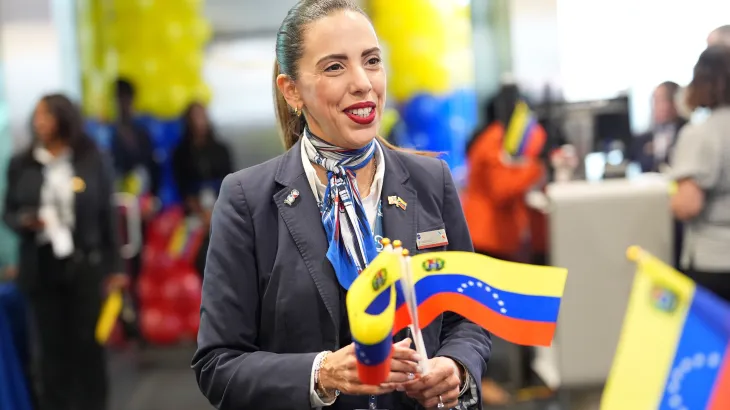
On January 3, 2026, American special-operations forces grabbed a sitting head of state out of Caracas and brought him to New York to face drug trafficking charges. That’s Operation Absolute Resolve. Ten months later, Venezuela without Maduro is a country ruled by the same elite under close US supervision. A sweeping oil deal was struck with Washington, an earthquake shook an already battered economy, showing its first real growth in years. And locals, at first cautiously optimistic, are now openly frustrated, waiting for the election that is being kicked down the road. In this overview we explore how this came to be and what is the current situation like.
Absolute Resolve was the final step of a slow-building campaign that began in early 2025 under a very different name: Southern Spear. A counter-narcotics and maritime-surveillance effort gradually mutated into a historic military buildup across the Caribbean and increasingly open talk in Washington about removing a sitting president of Venezuela, Nikolas Maduro.
The US-Venezuela relations crisis was years in the making. The legal justification came to life under the first Trump administration. Washington indicted Maduro back in March 2020 on narco-terrorism and cocaine-trafficking charges, accusing him and senior Venezuelan officials of running a long-running conspiracy to move cocaine through Venezuela with the protection of state institutions. That original indictment sat largely dormant for years. Then, in August 2025, the Trump administration dusted it off and raised the stakes, doubling the reward for information leading to Maduro’s arrest to $50 million. Through the second half of 2025, Washington was ramping up the pressure: strikes against suspected drug vessels began in the Caribbean and spread to the eastern Pacific, the Pentagon formally stood up Joint Task Force Southern Spear in November, and by December American forces were physically seizing sanctioned Venezuelan oil tankers. Then came January 3.
Under the codename Operation Absolute Resolve, the US launched a large-scale air and special-operations assault inside Venezuela. More than 150 aircraft took part. Venezuelan air defenses were suppressed before special-operations teams moved into Caracas itself, where they captured Maduro and his wife, Cilia Flores. Both were initially taken aboard the USS Iwo Jima before being transported to the United States for prosecution.
As of October 8, 2026, Maduro and Flores remain in US custody. Both have pleaded not guilty. A trial is scheduled for June 2027, which means the legal process still has the better part of a year to run. And on that same date, October 8, prosecutors unsealed yet another superseding indictment, this one adding allegations that Maduro and his co-defendants conspired to commit torture, including the alleged torture of American citizens who were held in Venezuelan custody during the Maduro years. It’s worth being precise here: these are allegations, freshly unsealed, and they remain entirely unproven in court. Whatever the eventual trial produces, the case has already become one of the most unusual prosecutions in the history of American foreign policy – not a trial of a terrorist or a non-state actor, but of a man who ran a country of thirty million people until the morning US forces came for him.
With Maduro now in US custody, what’s going on in Venezuela?
Contrary to what was expected of a regime-change operation, Washington didn’t hand power to the opposition it had spent years recognizing as Venezuela’s legitimate government. It worked with the people already running the machinery of the Venezuelan state.
Delcy Rodríguez, who had served as Maduro’s vice president, became acting president within hours of his capture, formally sworn in soon after. That decision – bypassing the opposition leadership the US had spent years backing, in favor of a senior figure from the very government it had just decapitated – is probably the single most consequential and most debated choice the Trump administration made after the raid.
What’s emerged since is a relationship best described, as several experts below put it, as coercive normalization. Washington restored diplomatic ties and actively promoted Venezuela’s economic reconstruction while simultaneously retaining extraordinary control over the levers that actually determine whether Venezuela’s government survives: oil revenue, sanctions, security policy, and the pace of any eventual political transition. Secretary of State Marco Rubio laid out the administration’s stated roadmap as a three-stage sequence: stabilization, economic recovery, reconciliation with eventual elections last.
From this arrangement Washington gets cooperation on oil, security, migration, organized crime, and – perhaps most strategically significant – on pulling Venezuela’s relationships with Cuba, Russia, and China. Caracas gets limited – hopefully for a time – sanctions relief, renewed access to international finance, diplomatic recognition, fresh investment, and substantial direct US assistance. Hundreds of political prisoners have also been released as part of the process. But a meaningful number of prisoners remain locked up, and the actual institutions that enabled political repression under Maduro haven’t been dismantled.
In April, Washington lifted sanctions on Rodríguez personally. The first half of 2026, Venezuela spent reconnecting with the IMF and other major international financial institutions like the World Bank it had been effectively locked out of for years. In late August, Washington and Caracas had negotiated a sweeping restructuring of the Venezuelan oil industry, and in September, Rodríguez herself traveled to the United States to personally negotiate debt, energy, and mining arrangements.
The latest news in your social feeds
Subscribe to our social media platforms to stay tuned