
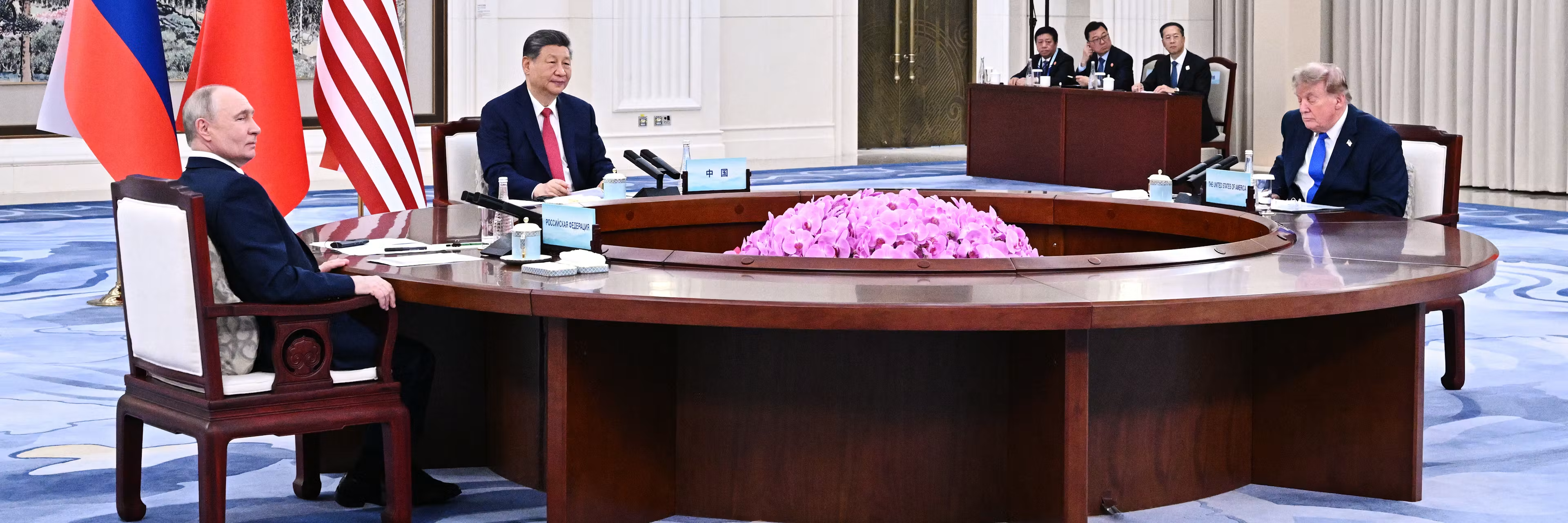

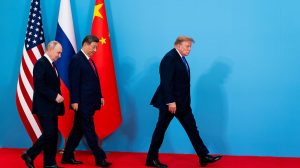
On November 19, 2026, Xi Jinping, Vladimir Putin and Donald Trump met in Shenzhen, China, on the sidelines of the Asia-Pacific Economic Cooperation (APEC) Summit. This historic meeting has been the subject of considerable analysis, with many commentators arriving at the curious conclusion that it represented a “New Yalta.” However, viewed from an Internationalist perspective, the Big Three Summit is perhaps better understood as a “Reverse Yalta,” with implications quite different from those suggested by the dominant narratives emanating from the Global North.
In February 1945, as World War II approached its conclusion, Franklin D. Roosevelt, Winston Churchill and Joseph Stalin convened in Yalta, Crimea, to negotiate the contours of the postwar world. It is a striking historical irony that Crimea, the site of that historic conference, remains a focal point of the US-NATO proxy war against Russia, with the Kerch Bridge subjected to successive Ukrainian strikes in the days leading up to and even on the day of the Shenzhen Summit.[1]
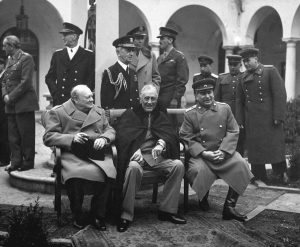
While the eight-day Yalta Conference produced several substantive agreements and the two-day Shenzhen Summit yielded virtually none, the latter may nevertheless represent a historic turning point — indeed, a reversal — in the international balance of forces.
In this Reverse Yalta, Xi Jinping occupies the position of Roosevelt, Putin that of Churchill, and Trump that of Stalin. While the other major belligerents suffered immense human and material losses during World War II, the US emerged with its industrial infrastructure largely untouched and its productive capacity vastly expanded. By 1945, the US accounted for approximately half of global manufacturing output and held two-thirds of the world’s gold reserves, laying the material foundations for its postwar hegemony. China is navigating the current period of global conflict relatively unscathed — even more so than the US did during World War II — while continuing to expand its industrial, technological and economic capacity.[2] Russia, much like Britain during World War II, has borne a disproportionate share of the fighting, effectively serving alongside countries like Iran as a geopolitical firewall for China. Just as Britain did not fight World War II for the benefit of the US, Russia and Iran have fought in pursuit of their own national interests, yet China has arguably emerged as the greatest strategic beneficiary.
Trump, meanwhile, much like Stalin at Yalta, finds himself the odd man out among the three leaders. Stalin arrived at Yalta representing a country whose military and economic resources had been severely strained by years of war, whose productive infrastructure had been devastated, and whose economy faced the enormous task of reconstruction. Similarly, Trump arrived in Shenzhen representing a militarily overextended power with increasingly strained resources, a mounting economic crisis and a deteriorating position in the global balance of forces. The fundamental difference, however, is that the Soviet Union’s exhaustion was the product of a devastating war, whereas the exhaustion of the US is arguably the product of decades of imperial overreach.
Of course, Yalta did not mark the beginning of an era of peaceful coexistence. On the contrary, it helped establish the contours of the Cold War that would dominate international relations for nearly half a century. Similarly, the Shenzhen Summit may come to represent a turning point in the present era of “Counter-Revolution,” a period characterized by the collapse of the Socialist Camp and the subsequent consolidation of US imperial hegemony, as articulated by Vijay Prashad.[3] Whereas Yalta marked the ascendancy of US imperialism, Shenzhen may come to symbolize its decline. Perhaps Trump was inadvertently correct when he characterized the summit as “bigger than Yalta,” albeit for reasons quite different from those he intended.[4]
A Reverse Berlin Conference
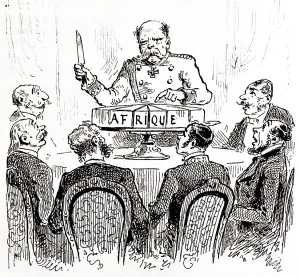
To a lesser extent, the Big Three Summit can also be understood as a sort of Reverse Berlin Conference. From November 1884 to February 1885, the imperial powers convened in Berlin to establish the terms for the colonial partition of Africa, without a single African representative at the table. Nearly a century and a half later, three world powers convened in Shenzhen to discuss, among other things, the geopolitical future of Europe, without a representative of the European Union at the table. That discussions concerning the geopolitical future of Europe should take place on Chinese soil, itself once subjected to European colonialism and US imperialism, only adds to the historical irony.
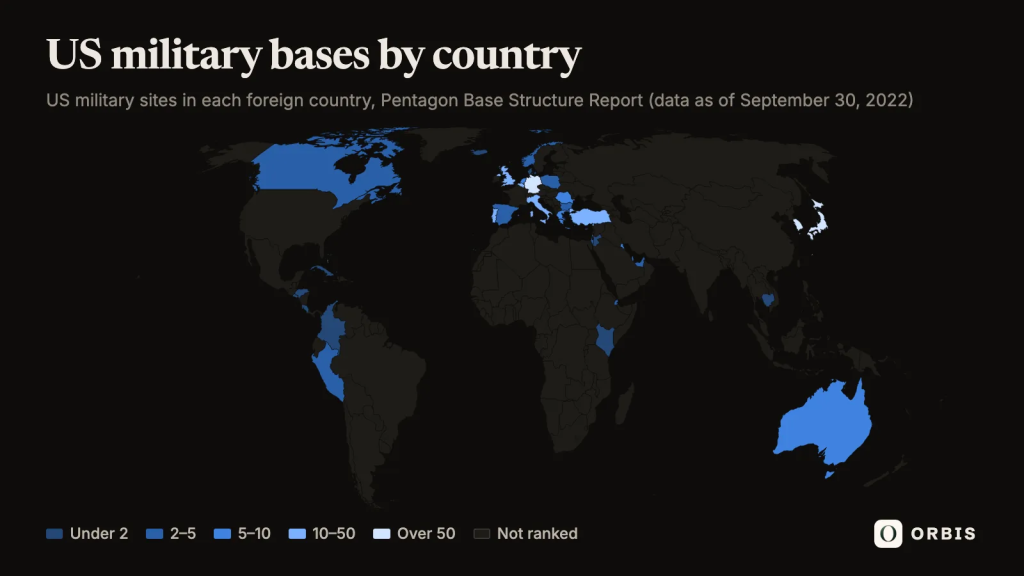
In the aftermath of World War II, the socialist countries of Eastern Europe were routinely derided in the West as Soviet “satellite states.” Yet the intervening decades have arguably revealed that the enduring satellite states of the postwar order are to be found in Western Europe. The US-NATO proxy war against Russia has laid bare the extent of this subordination and the limits of European sovereignty.
Not only do numerous European countries continue to host US military bases eight decades after the conclusion of World War II, but their governments continue to take their marching orders directly from Washington, even to the point of sacrificing their own energy security, deindustrializing their countries, undermining their own economies and jeopardizing their own political survival, all in service of US imperialism’s increasingly desperate efforts to regain hegemony. This contradiction helps explain the growing social unrest and political instability across Europe. Yet much of this popular discontent is being channeled into an electoral contest between an ascendant far right and an ostensibly left or centrist establishment, both of which remain fundamentally Atlanticist in their geopolitical orientation, looking West toward Washington rather than East toward Eurasian integration. As Vijay Prashad has articulated, Europe’s “principal contradiction is held by the Atlantic alliance, their subordination to the United States.”[5] Against this backdrop, the absence of the European Union from the negotiating table in Shenzhen is less an aberration than a manifestation of its longstanding geopolitical subordination.
There is, however, another historical irony worth noting. Ethiopia, one of the few African nations to retain its independence during the Scramble for Africa, has for centuries resisted successive attempts at foreign domination. As Gerald Horne documents in his latest book, in 1875, less than a decade before the Berlin Conference, former Confederate military officers were recruited by Egypt to lead an invasion of Ethiopia, the success of which could have expanded the enslavement of Africans.[6] Ethiopia’s historic victory over Italy at Adwa in 1896 did not extinguish European colonial ambitions, as evidenced by fascist Italy’s invasion in 1935 and subsequent occupation until 1941. Nearly a century and a half after the Berlin Conference, Ethiopia again finds itself confronting attempts at destabilization by regional powers, including Egypt, Sudan, Eritrea and Israel, whose activities can be understood within the broader framework of US imperialism and its reliance on regional proxies. While the global balance of forces may be undergoing a historic reversal, the struggle against imperialist domination of Ethiopia and the African continent is far from over.
In assessing this historic reversal in the international balance of forces, particular attention must also be paid to Japan and India. As Gerald Horne has repeatedly cautioned, even if US imperialism were successful in its efforts to destabilize China, this would not necessarily enable it to regain hegemony, given the emergence of other constellations of power, not least what Horne has termed the “condominium between Tokyo and New Delhi.”[7] The historical relationship between these two Asian powers, their considerable economic and military capacities, and their respective geopolitical ambitions warrant close scrutiny. The decline of US imperialism is, after all, not simply a function of the ascent of China, but of a much broader redistribution of economic and political power on a global scale.
The Imperative of Internationalism
For Internationalists, the significance of the Big Three Summit extends well beyond an interest in current events or foreign affairs. As we outlined in an earlier article, The Urgent Need for Internationalism on the Left in the US, Internationalism requires both (a) a rigorous assessment of global currents — keeping up with the news — and (b) a firm grasp of history — historical materialism.
It is this political and historical analysis that helps us understand and navigate the contradictions of our time and recognize and capitalize on openings in the global balance of forces, and that gives us the requisite confidence to advance our collective struggle by forging alliances across national, political and ideological boundaries. The decline of US imperialism presents such an opening, but it is incumbent upon us to seize it.
As Internationalists, such historic openings reinforce the point that we cannot afford to allow Washington to dictate who our friends and enemies are, nor can we afford to wait for ideologically perfect allies. US imperialism has never hampered itself by requiring ideological conformity from its allies. Why should we?
[1] Lina Golovnya and Andrew Osborn, Reuters, “Ukraine Cripples Crimean Road Bridge in Blow to Putin Before Meeting with Xi and Trump,” November 17, 2026; see also Reuters, “Ukraine Strikes Crimean Bridge for Third Time in a Week Ahead of US-China-Russia Summit,” November 19, 2026.
[2] It must be noted, however, that one of the historical contradictions underlying this reversal, as Gerald Horne has repeatedly articulated, is that China’s rapprochement with US imperialism in the 1970s on an anti-Soviet basis helped lay the foundations for its subsequent economic ascent. In seeking to undermine the Soviet Union, US imperialism inadvertently facilitated the emergence of its principal geopolitical rival of the twenty-first century. See, Gerald Horne, “Can US Remain an Asian Power?” theAnalysis.news, July 12, 2021; see also the conversation between Richard Nixon and Henry Kissinger, February 14, 1972, Foreign Relations of the United States, 1969–1976, Volume I, Document 105.
[3] Vijay Prashad, interview with India & Global Left, November 2026, 15:25–16:13. Prashad explicitly characterizes the period beginning in the 1990s as the “era of counter-revolution.”
[4] Reuters, “Trump, Xi and Putin Release ‘Peace Declaration’ from Unprecedented Summit,” November 19, 2026.
[5] Vijay Prashad, interview on European subordination to the United States and the rise of the far right, 15:28–15:35.
[6] Gerald Horne, Slavery, the Slave Trade and the Roots of US Imperialism: North Africa, Egypt, Sudan, Ethiopia, West Asia, Ottoman Turkey, Western Europe and Russia (International Publishers, 2026).
[7] Gerald Horne, interview on The Horne Report on Diasporic Music, Black Power 96, November 8, 2026, 22:31–24:31. His specific reference to the “condominium between Tokyo and New Delhi” occurs at 23:27.


The latest news in your social feeds
Subscribe to our social media platforms to stay tuned