
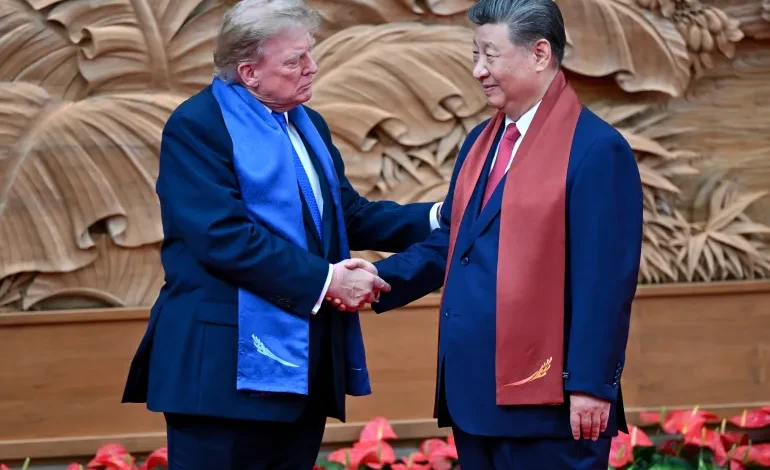

US President Donald Trump has opened a new phase in his trade confrontation with China, less than two years after his return to the White House triggered a dramatic escalation in tariffs between the world’s two largest economies.
The dispute began in February 2025, when Washington imposed a 10 percent duty on Chinese goods, citing concerns over fentanyl and immigration.
Beijing responded by restricting exports of five rare earth metals used in defence, clean energy and advanced technology.
The confrontation intensified in April with Trump’s “Liberation Day” tariffs, which included a 34 percent levy on Chinese products.
A rapid series of retaliatory measures followed.
Headline US tariffs on Chinese imports eventually climbed as high as 145 percent, while China imposed duties of up to 125 percent on US goods and tightened restrictions on rare earth exports.
The tariff battle continued for much of 2025 before Trump and Chinese President Xi Jinping reached a temporary truce during the Asia-Pacific Economic Cooperation summit in South Korea in October.
That pause helped open the door to a broader diplomatic thaw.
Trump travelled to Beijing in May for talks with Xi, while the Chinese president made his first visit to Washington in more than a decade in September.
Earlier this month, Trump and Xi met again in Shenzhen during this year’s APEC summit, where Trump publicly greeted the Chinese leader warmly.
But less than a week after returning to Washington, the Trump administration unveiled another tariff strategy.
The move follows a Supreme Court ruling that declared the administration’s earlier “Liberation Day” tariffs illegal.
“The practical purpose is simple: rebuild [the] tariff leverage the Supreme Court stripped away and force Beijing to the table before the next summit,” Alicia Garcia-Herrero, chief economist for Asia Pacific at investment bank Natixis, told Al Jazeera.
This time, Washington is targeting 14 major trading partners, including China, the European Union and India.
The administration says those economies have contributed to “structural excess capacity” by supporting industries through subsidies, industrial policies and suppressed wages, allowing cheaper goods to flood global markets.
China faces the highest new tariff rate: 20 percent.
That remains within the terms of the current US-China trade truce, which expires in January, although Washington has warned that the rate could rise to 40 percent if negotiations break down.
Unlike the earlier tariffs, which relied on emergency powers later rejected by the Supreme Court, the administration is now using Section 301 of the Trade Act of 1974.
The provision gives the US government authority to respond to foreign trade practices it considers unfair.
Washington identified the 14 targeted economies following an eight-month investigation launched in March by US Trade Representative Jamieson Greer.
China is viewed by the administration as the central focus, particularly in industries including steel, aluminium, electric vehicles, household appliances and solar panels.
Deborah Elms, head of trade policy at the Hinrich Foundation in Singapore, said the investigation initially appeared designed to create a more durable legal route back to the tariff levels announced under the earlier policy.
“Over that time, I think the purpose changed somewhat,” Elms told Al Jazeera.
“Originally a means to apply tariffs, it seems clear that the White House wants a more sweeping use of Section 301, which allows a broad range of activities to be subject to possible negotiations and future punishment like tariffs,” she said.
The timing is significant because Trump is due to meet Xi again next month at the G20 summit in Miami.
“This announcement adds another layer of possible tensions,” Elms said.
Beijing has responded cautiously but firmly.
Just before Trump arrived in Shenzhen this month, Xi opened the APEC leaders’ meeting with a call to “reduce barriers to trade and investment”.
China has increasingly presented itself as a supporter of predictable global trade while urging Washington to resolve disputes through negotiations.
Following the latest US announcement, Beijing said it “reserves the right” to retaliate with higher tariffs.
“China urges the US to correct its wrong practices and return to the right track of resolving issues through dialogue and consultation,” a Ministry of Commerce spokesperson said.
The spokesperson added that Beijing “will resolutely safeguard its legitimate rights and interests”.
China also criticised the US investigation into “structural excess capacity”, describing it as “a typical act of unilateralism that severely disrupts the international economic order and seriously violates WTO rules”.
The latest strategy also expands the dispute beyond direct US-China commerce.
Washington is increasingly focusing on countries that have emerged as alternative manufacturing centres but remain deeply integrated into Chinese supply chains.
That approach could make the next phase of the trade confrontation significantly broader than the tariff battle that began in early 2025.
Elms said Beijing could probably absorb the immediate 20 percent tariff more easily than the wider attempt to pressure other US trading partners over their economic ties with China.
While the direct tariff burden remains manageable for now, the bigger question is whether Washington’s new Section 301 strategy becomes a negotiating tool ahead of the Miami summit or the foundation for a more expansive restructuring of global trade.

The latest news in your social feeds
Subscribe to our social media platforms to stay tuned