
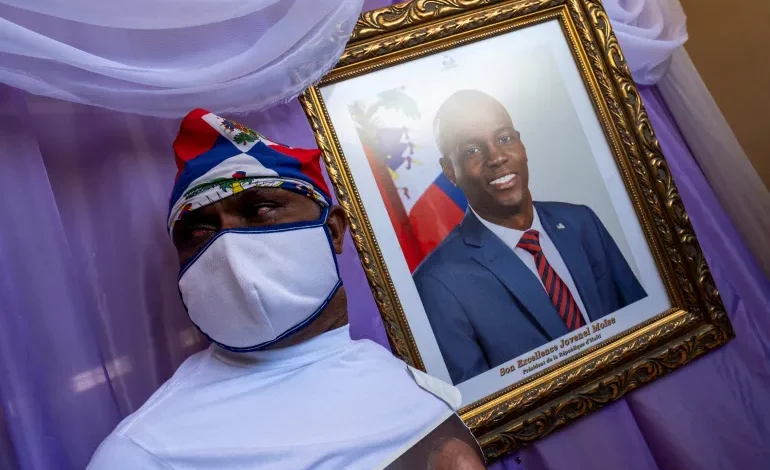

A Florida pastor with dual Haitian-American citizenship has been convicted in the United States over his role in the 2021 assassination of Haitian President Jovenel Moise.
Christian Emmanuel Sanon, 68, was found guilty on Wednesday on all eight charges after a nearly eight-week federal trial in Miami.
The charges included conspiracy to kill Moise, who was shot dead at his home outside Port-au-Prince on July 7, 2021.
Prosecutors said the plot involved roughly two dozen foreign mercenaries and was financed in part with money obtained through US government programmes designed to support businesses during the COVID-19 pandemic.
According to court records, South Florida became a key centre for planning and financing an effort to remove Moise and replace him with a president chosen by the conspirators.
Sanon acknowledged during the trial that he had been in contact with people seeking to replace Moise, but said the group had settled on another candidate long before the assassination.
He denied knowing about any plan to kill the president and maintained his innocence throughout the proceedings.
Sanon was arrested in Port-au-Prince days after the killing.
According to a local police report seen by Reuters, officers searching his residence found eight vehicle registration plates, 19 passports and 12 mobile phones, along with 30 boxes of ammunition and 12 pistol holsters.
Moise’s widow, Martine Moise, was one of the trial’s key witnesses.
She was seriously wounded in the attack and flown to Florida for treatment.
She has since registered as a candidate in Haiti’s 2027 presidential election, which is expected to be the country’s first general election in more than a decade.
Sanon showed little reaction as the verdict was read.
He remains in federal custody and faces up to life in prison. Sentencing is scheduled for February 10.
His lawyer, Zeljka Bozanic, said the defence was disappointed with the outcome and planned to appeal.
Prosecutors declined to comment after the verdict.
The US investigation into Moise’s killing has expanded far beyond Sanon.
More than 40 people have been charged in connection with the assassination, and 12 have already been convicted. Five of them are serving life sentences.
A new round of indictments announced in September included four unnamed defendants whose identities were redacted.
Seven others have been charged with helping finance the plot or assisting suspects after the assassination.
Among them is Vitel’homme Innocent, a gang leader also linked to the kidnapping of 17 US and Canadian missionaries later in 2021. He has not been arrested.
Others still awaiting trial include Joseph Felix Badio, a former government anti-corruption official whom defence lawyers for other suspects have accused of masterminding the operation, as well as 17 former Colombian soldiers who were transferred from Haiti in September.
Moise’s assassination triggered a deeper political and security crisis in Haiti.
The country has not had a president since the killing, and successive transitional governments have struggled to restore stability as armed groups expanded their control over Port-au-Prince and nearby areas.
The United Nations Human Rights Office recorded 4,595 deaths from armed violence between January 1 and October 31 this year.
The wider crisis has also displaced nearly 1.5 million people, according to the UN, worsening already severe humanitarian and economic pressures.

The latest news in your social feeds
Subscribe to our social media platforms to stay tuned