
EXCLUSIVE: What 2028 Betting Markets Are Really Saying After Midterms
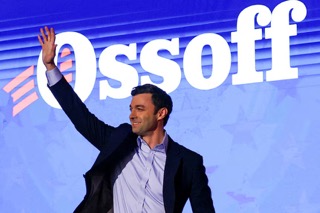

Jon Ossoff and James Talarico moved sharply in early 2028 political betting after Democrats’ sweeping midterm gains. BetOnline Brand Manager Dave Mason says the shifts reflect both new political information and real money entering the market, but two years out, the numbers remain highly fluid.
The 2028 presidential election is still nearly two years away, no major-party nominee has been chosen, and much of the field has not even formally declared an interest in running. The betting markets, however, are already moving.
Democrats’ sweeping performance in the 2026 midterms changed control of Congress and elevated several politicians almost overnight from state-level or Senate figures into the early national conversation. Jon Ossoff, who won reelection to the Senate in Georgia, and James Talarico, who flipped a Republican-held Senate seat in Texas, were among the clearest examples.
The broader scale of the Democratic gains was unusually large. The party flipped nine Republican-held Senate seats, its largest midterm Senate pickup in nearly 70 years, and will enter the new Congress with a 56-44 majority. Democrats also regained control of the House.
Within days, those results were being reflected in 2028 political odds.
BetOnline initially moved Ossoff to 3/1 for the Democratic nomination and 9/2 in its presidential market following the midterms. Talarico, who had not previously been a significant presence on the board, was added at 40/1 for the Democratic nomination and 60/1 for the presidency.
The numbers have continued moving since then. As of Nov. 23, BetOnline listed Ossoff at +230 in its Democratic nominee market and +400 in its presidential election market, while Talarico had shortened to +1800 for the Democratic nomination.
Those prices are notable. But they are not the same thing as polling numbers, and they should not be read as a settled forecast of what voters will do in 2028.
Dave Mason, Brand Manager at BetOnline, told the Wyoming Star that the Ossoff movement was driven by a combination of political reassessment and betting activity.
“It’s a bit of both, to be honest,” Mason said.
BetOnline had already begun shortening Ossoff’s price before Election Day as expectations of Democratic gains strengthened, Mason said. The scale of the eventual results then produced another burst of activity.
“We started shortening Ossoff’s 2028 odds more than a month ago when the Blue Wave picture really started manifesting in its early stages,” he said. “Of course, when the Blue Tsunami hit, everyone scrambled to bet on Ossoff, so we adjusted his odds even further.”
The terminology is Mason’s, but the mechanics behind it illustrate an important distinction in political betting: odds react both to events and to the people betting on those events.
Betting odds are not opinion polls
A poll asks a sample of voters how they currently intend to vote or how they view a candidate.
A political betting market asks something different. Participants put money behind an outcome, while the sportsbook sets and adjusts the price at which it is prepared to take those wagers.
That means a move in odds can contain several signals at once.
An election result can cause bookmakers to reassess a politician’s national profile. Bettors may then react to the same result by placing money on that politician. The sportsbook can move the price again in response to that activity and its resulting financial exposure.
Mason’s description of Ossoff’s rise contains all three elements: the sportsbook was already responding to changing political conditions before the election, then actual wagers accelerated after the result.
That makes political odds useful as a measure of changing expectations, but not a clean substitute for polling or a statistical election model.
Academic research on prediction markets has found that prices can provide useful information about the average beliefs of market participants, while also cautioning that those prices can be biased. Political markets may be relatively thin, can react sharply to news and polling, and sometimes amplify short-term changes in sentiment.
A sportsbook introduces another layer because it is not merely observing a market price. The bookmaker itself quotes the odds and manages the risk created by customers’ wagers.
So when Ossoff moves from a distant position on a futures board to one of the shortest prices available, the correct reading is not that a bookmaker has determined who will win in 2028.
It means the market’s assessment of him has changed substantially.
Why Ossoff suddenly looks different to the market
There is a straightforward reason the Georgia senator attracted attention.
Ossoff did not merely survive a difficult midterm environment. He won reelection in a state Donald Trump carried in 2024, defeating Republican Mike Collins while building a much larger national profile during the campaign. The Associated Press described Ossoff’s victory as securing a crucial Democratic-held seat and noted that his campaign raised more than $100 million.
That gives a political market something concrete to price.
Presidential speculation years before an election often revolves around politicians whose ability to build a national coalition remains largely hypothetical. A statewide election in a competitive state provides actual voter data, fundraising performance, media exposure and evidence of how a candidate operates under sustained opposition.
It still says little about how that politician would perform in a future presidential primary, much less a general election two years later.
But it changes the information available.
That distinction helps explain why a large electoral event can produce a sudden adjustment. The midterms did not answer the 2028 question. They supplied new evidence that bettors and bookmakers could incorporate into it.
Mason said readers should pay attention to such movement while keeping the timeframe firmly in mind.
“They should take these odds and movement seriously, but also understand that so much could change in the next two years,” he said.
That may be the most useful way to read an early political futures market: as a snapshot of expectations at a particular moment rather than a photograph of Election Day 2028.
The Trump lesson — long shots can become central players
Political betting history provides plenty of reasons for caution.
Mason pointed to Donald Trump’s path before the 2016 election as an example of how radically an early futures market can change.
Historical bookmaker data supports the broader point. William Hill at one stage offered Trump at 150/1 to become president, before his odds shortened dramatically as his candidacy developed. By August 2015, the bookmaker had moved him to 14/1, and he ultimately won the 2016 election.
That history does not mean long-shot candidates should be assumed to have hidden strength. It demonstrates something simpler: two years in American politics contain an enormous amount of information that does not yet exist.
Candidates can decline to run. Campaigns can collapse. New contenders can emerge. Economic conditions can change. Foreign-policy crises, scandals, primary rules, fundraising and voter priorities can all reshape a race.
Even much closer to Election Day, betting markets can diverge considerably from the final result. Trump entered the 2016 election as the longer-priced candidate in major betting markets before defeating Hillary Clinton.
The implication for 2028 is not that current odds are meaningless. It is that their meaning is time-sensitive. They tell a story about what the political world values today. They do not lock in the story that will exist two years from now.
Talarico shows how quickly a new name can enter the conversation
James Talarico’s movement may be even more revealing than Ossoff’s.
Before the midterms, the Texas state legislator was not generally treated as a central figure in national presidential speculation. Then he defeated Republican Ken Paxton in Texas’s U.S. Senate race, becoming the first Democrat to win a Texas Senate election in decades.
The victory immediately gave Talarico something early presidential markets tend to reward: a major electoral result in a state that had previously leaned strongly toward the opposing party.
His campaign also arrived with a ready-made national narrative. Talarico, a former middle school teacher and Presbyterian seminarian, emphasized cost-of-living issues and political corruption while building a substantial social-media presence. AP voter analysis found that he performed strongly among young voters, Hispanic voters, moderates and independents, while also receiving support from a minority of Republicans.
BetOnline responded by adding him to its 2028 markets.
Mason said the sportsbook had already been monitoring Talarico before his Senate victory.
“We’d been watching this guy for a couple of years as he created some vitality on social media,” he said.
The midterm result then changed the calculation.
Talarico initially appeared at 40/1 for the Democratic nomination. By Nov. 23, BetOnline’s live board had him at +1800, a substantial further adjustment in only a matter of weeks.
Again, that should not be confused with a prediction about whether he will run, win a primary or become president.
It shows that the sportsbook has moved from treating him as essentially outside the main 2028 discussion to assigning a meaningful price to that possibility. That is a different kind of political signal.
Markets measure attention as well as conviction
The distinction matters because presidential speculation has its own feedback loop.
A politician wins an important race. Media coverage increases. Voters outside the state learn the politician’s name. Donors become interested. Social-media attention rises. Bookmakers add or shorten the candidate. The movement in the odds then generates another round of headlines about that candidate’s national prospects.
In other words, betting markets do not merely observe political narratives. They can become part of them.
Mason acknowledged that role directly, describing betting forecasts as important in “shaping the narrative,” even when the eventual outcome remains highly uncertain.
That makes early odds particularly interesting after an election like 2026.
Democrats did not simply pick up a few competitive seats. Their victories extended into states that had strongly supported Republicans only two years earlier, including Texas and Iowa, while the party regained both chambers of Congress.
A result of that scale naturally changes the pool of politicians viewed as nationally significant.
But it can also encourage overinterpretation.
Midterm electorates are not presidential electorates. A Senate campaign is not a presidential primary. A politician who fits one political moment may not fit another.
Two years before an election, betting prices are therefore as much a map of current political attention as a judgment about the distant final outcome.
What the numbers actually tell us
The most defensible conclusion from the post-midterm movement is narrower than the headline odds might suggest.
Ossoff’s reelection changed how the betting market values his national political position. Talarico’s Texas victory was significant enough to move him from outside the conversation onto the 2028 board — and then substantially shorten his price within weeks.And bettors themselves played a role in both processes.
That tells us something real about political momentum.It does not tell us who will be president in January 2029. For now, the 2028 board is best understood as a continuously updating ledger of political information, money and attention.
Every election result, candidate decision, poll, fundraising report and major event gives bookmakers and bettors something new to process. The 2026 midterms gave them a great deal of new information at once.
The resulting odds tell us who has gained attention from the market. The next two years will determine whether that attention lasts.
The latest news in your social feeds
Subscribe to our social media platforms to stay tuned