
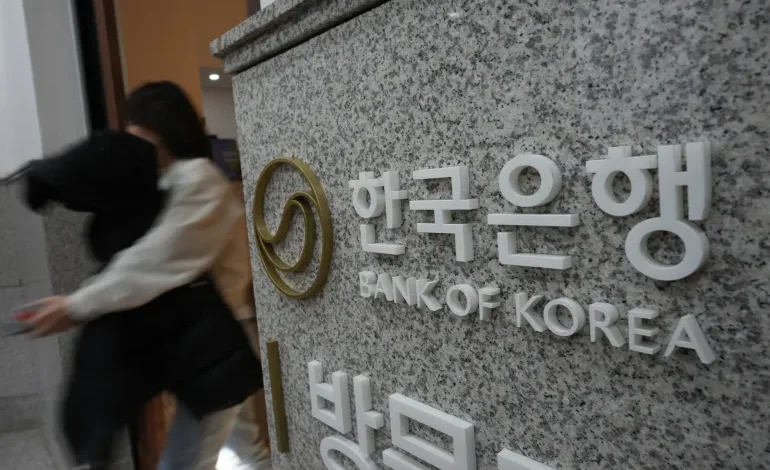

South Korea’s central bank has raised interest rates as surging semiconductor demand and heavy investment in artificial intelligence push the economy towards its strongest expansion in years.
The Bank of Korea increased its benchmark rate by 0.25 percentage points to 3.25 percent on Thursday, pointing to stronger-than-expected growth and inflation that remains above target.
Despite continuing tensions in the Middle East, the central bank said the global economy was likely to maintain a favourable growth trend, supported by “robust AI investment”.
At the same time, it warned that inflation would “stay elevated for some time” as higher energy prices feed through the economy.
“Looking ahead, the global economy and financial markets will be affected by the AI investment outlook, by changes in monetary and fiscal policies in major economies, and by developments in the Middle East,” the Bank of Korea said.
South Korea’s inflation rate stood at 2.8 percent in October, above the central bank’s 2 percent target.
The BOK also sharply upgraded its growth forecasts.
It now expects gross domestic product to expand 3.9 percent in 2026 and 4.1 percent in 2027, compared with forecasts in August of 3.3 percent and 2.9 percent respectively.
Much of that optimism comes from the semiconductor sector.
South Korea is home to SK Hynix and Samsung Electronics, two of the world’s most important memory-chip manufacturers, and has emerged as one of the biggest beneficiaries of the multi-trillion-dollar wave of investment in artificial intelligence.
Exports jumped 94 percent year-on-year in October to $115.3bn, following a record $120.9bn in September.
Semiconductors accounted for nearly half of total exports.
SK Hynix and Samsung Electronics together control around 80 percent of the global market for high-bandwidth memory and about 60 percent of the market for dynamic random-access memory, according to Counterpoint Research.
The wider economy has also accelerated.
GDP grew 3.4 percent year-on-year in the July-to-September quarter, comfortably beating forecasts.
Excluding the unusual swings seen during the COVID-19 pandemic, Asia’s fourth-largest economy is now on course for its strongest performance since 2010, when GDP expanded 6.2 percent.
The rate increase reflects the other side of that strength.
Rapid growth, booming exports and continued investment are supporting activity, but they also make it harder for the central bank to bring inflation back towards its 2 percent target.
Financial markets took the decision in stride.
After a technology-led sell-off the previous day, South Korean stocks recovered on Thursday alongside gains elsewhere in Asia.
Seoul’s Kospi closed 0.3 percent higher, while Japan’s Nikkei 225 rose 0.9 percent and Taiwan’s Taiex gained 2.5 percent.
For South Korea, the AI investment boom is creating an unusual policy mix: the same chip demand driving faster growth is also giving the central bank more reason to keep monetary policy tight.

The latest news in your social feeds
Subscribe to our social media platforms to stay tuned