
Trump Announces Tariffs on Steel, Aluminum Imports

Reuters, the Guardian, and the White House contributed to this report.
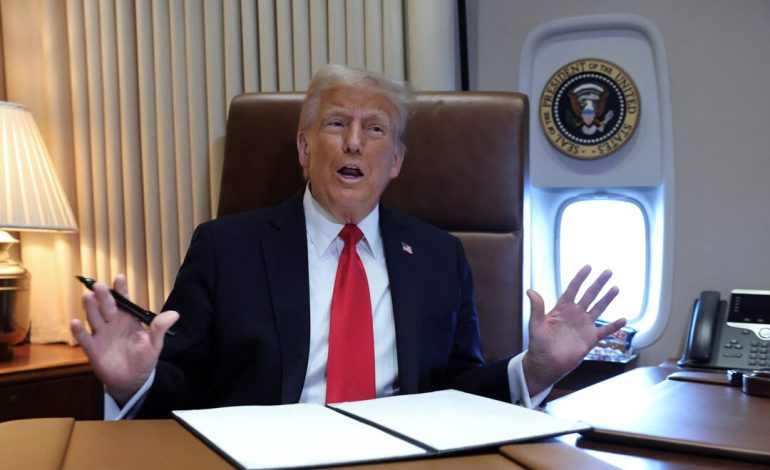
Trump is turning up the heat on trade. On Sunday, speaking to reporters aboard Air Force One on his way to the Super Bowl, the president said he’ll announce new 25% tariffs on all steel and aluminum imports into the US on Monday – on top of existing metals duties. No more carve-outs. No more exemptions.
“If they charge us, we charge them,” he said, previewing a separate plan for reciprocal tariffs that would match the rates other countries levy on American goods.
The details matter. Trump’s first-term tariffs – 25% on steel, 10% on aluminum – came with exemptions for Canada, Mexico, Brazil, and others. Later, Biden negotiated duty-free quotas with Britain, the EU, and Japan. The new proclamations, according to the White House, close those loopholes. The countries that had exemptions – Argentina, Australia, Brazil, Canada, Japan, Mexico, South Korea, the EU, Ukraine, and the UK – are now on the hook. The White House says the exemptions “inadvertently created loopholes that were exploited by China and others with excess steel and aluminum capacity.”
Canada is the biggest supplier of primary aluminum to the US, accounting for 79% of imports in the first 11 months of 2024. It’s also a major steel source, along with Brazil and Mexico. Canadian Innovation Minister François-Philippe Champagne responded on X:
“Canadian steel and aluminum support key industries in the US from defence, shipbuilding and auto. We will continue to stand up for Canada, our workers, and our industries.”
Quebec Premier François Legault was blunter:
“Quebec exports 2.9 million tons of aluminum to (the US), that is, 60% of their needs. Do they prefer to get supplies from China?”
He called for renegotiating the USMCA free trade agreement “as soon as possible.”
The politics are messy. Trump also said he’d allow Japan’s Nippon Steel to invest in US Steel – but not take a majority stake.
“Tariffs are going to make it very successful again,” he said.
Nippon Steel declined to comment. The reciprocal tariff plan, which Trump said he’d detail Tuesday or Wednesday, would apply to all countries and match the rates each one charges. The US trade-weighted average tariff is about 2.2%, according to WTO data – compared to 12% for India, 6.7% for Brazil, 5.1% for Vietnam, and 2.7% for the EU. Trump has long complained about the EU’s 10% tariff on auto imports versus the US rate of 2.5%.
Not everyone is cheering. Chris Swonger of the Distilled Spirits Council warned that the steel tariffs could prompt the EU to reimpose retaliatory duties on American whiskey and raise them to 50%.
“A 50% tariff on America’s native spirit will have a catastrophic outcome for the 3,000 small distilleries across the United States,” he said.
The American Iron and Steel Institute, by contrast, welcomed Trump’s commitment. CEO Kevin Dempsey said the group looks forward to working with the administration “to implement a robust and reinvigorated trade agenda to address the many foreign market-distorting policies and practices that create an unlevel playing field for American steelmakers.”
There’s also the Canada and Mexico question. Trump has threatened 25% tariffs on all imports from both countries unless they do more to secure their borders and stop drugs and migrants. He paused those tariffs until March 1 after Mexico pledged 10,000 National Guard troops and Canada deployed new technology and personnel. Asked Sunday whether their actions were sufficient, Trump said:
“No, it’s not good enough. Something has to happen, it’s not sustainable, and I’m changing it.”
He didn’t say what they needed to do to avoid the March 1 deadline.
The White House is framing the metals tariffs as a national security necessity. The proclamations invoke Section 232 of the Trade Expansion Act of 1962, which allows the president to adjust imports that threaten national security. The White House says steel capacity utilization briefly hit 80% in 2021 but fell to 77.3% in 2022 and 75.3% in 2023. Aluminum capacity utilization rose from 40% to 61% between 2017 and 2019, then fell to 55% by 2023.
“The United States does not want to be in a position where it would be unable to meet demand for national defense and critical infrastructure in a national emergency,” the White House said.

The latest news in your social feeds
Subscribe to our social media platforms to stay tuned