
Food Banks Struggle to Fill Gaps After Suspension of Federal Shipments

With input from the New York Times and CNN.
Food banks are in trouble, and it’s not because people stopped being hungry. The Trump administration has frozen roughly $500 million in shipments of produce, poultry, eggs, milk, and other staples that states had planned to distribute through the Emergency Food Assistance Program. The money came from the Commodity Credit Corporation, a USDA fund that buys food from farmers and sends it to food banks. Now, many of those deliveries are on hold – and nobody seems to know for how long.
Vince Hall, chief of government relations for Feeding America, said when he asked USDA officials about the suspended shipments, he was told the department is reviewing the food aid programs funded through the CCC. It’s unclear whether that review has anything to do with Elon Musk’s DOGE team, which has been cutting spending across the government. The USDA didn’t respond to requests for comment. Politico first reported the freeze.
This isn’t happening in a vacuum. Earlier this month, the USDA halted two other programs that distributed food to food banks and schools – about $1 billion in funding. Lawmakers are also considering cuts to SNAP, the food stamp program used by roughly 42 million people in fiscal 2023. Food bank directors worry that an across-the-board contraction in federal food assistance could push more people to their doors just as they’re losing critical supplies.
“This is perhaps the first moment in the history of food banking that we have seen record low unemployment and record high demand at food banks,” Hall said. “Any circumstance that would cause even a modest increase in demand at food distributions will result in a food crisis.”
The pain will vary by state, but rural communities are likely to feel it worst. Hall called emergency food assistance programs “the food lifeline for rural America” because they come with funding to improve storage and distribution – things that are harder in remote areas. In Oregon, the Oregon Food Bank is expecting to lose 30 truckloads of food.
“It’s really hard to make up that volume that C.C.C. had been providing, especially at a time when the need is so great,” said Danny Faccinetti, vice president of the Oregon Food Bank.
The state’s food banks saw a 31% increase in use in fiscal 2024 compared with the prior year. In late 2024, the frozen funds made up 18% of all food aid they distributed.
In Maryland, food banks were told they’d lose 12 truckloads of chicken, eggs, collard greens, and blueberries – plus four more shipments, totaling almost $1.3 million in lost goods. They think they can weather the immediate hit without shortchanging the roughly one million people who rely on them. In Virginia, Eddie Oliver of the Federation of Virginia Food Banks said one food bank lost seven loads of food – about a third of what it expected through the Emergency Food Assistance Program this year.
“It’s going to be hard for us to replace that,” he said.
Virginia food banks are already spending five times more on food than they did in 2019, thanks to higher prices and greater demand.
West Virginia’s Facing Hunger food bank is bracing for a specific kind of loss.
“One thousand fifty cases of cheese; boned chicken by the can, 600 cases; fresh milk, 1,200 cases – all that stuff’s not coming,” said CEO Cynthia D. Kirkhart.
In New Mexico, Roadrunner Food Bank is expecting to miss 24 truckloads of milk, cheese, cranberries, and meats between April and June. The state has allocated some extra funds, but it’s not enough.
“None of us have crystal balls, but what we can do is encourage the community to get involved and get engaged,” said communications director Sonya Warwick.
California’s Central California Food Bank recently learned that 13 truckloads of groceries worth $850,000 were canceled.
“My food bank in Fresno can’t magically come up with $850,000 and 500,000 pounds of food to backfill that cancelation,” said co-CEO Natalie Caples.
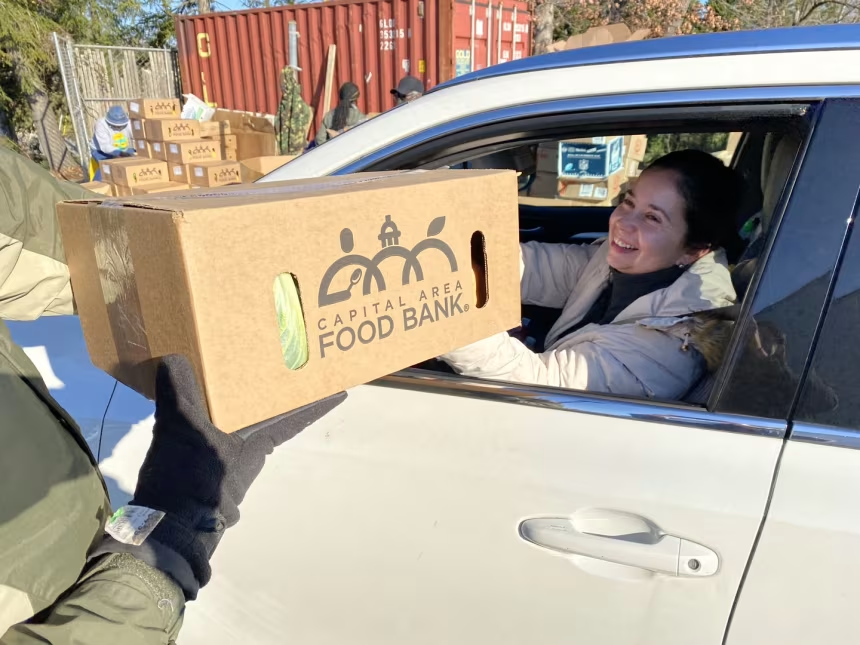
The nonprofit is already running a deficit. In the Washington, DC, metro area, the Capital Area Food Bank is trying to replace $1.3 million in canceled deliveries – 27 trucks containing the equivalent of 670,000 meals. CEO Radha Muthiah said they’re turning to retailers, corporations, foundations, and individual donors to close the gap, though it won’t be easy in such a short time.
“We are really trying very hard not to reduce the amount of food that flows through our network,” she said.
Not every food bank has that option. Feeding Southwest Virginia, which serves 26 mostly rural counties, had 10 truckloads worth $513,000 paused. CEO Pamela Irvine said the nonprofit doesn’t have the resources to replace them.
“We have to make some tough decisions, much like the families or neighbors that are struggling now,” she said. “It could be that some of our agencies and programs will have to provide less food, or it could be that we provide food to less neighbors.”
The USDA, for its part, said the Biden administration created “unsustainable programming and expectations” using the Commodity Credit Corporation. The agency noted it continues to buy food for The Emergency Food Assistance Program, spending more than $166 million so far this fiscal year, and has purchased more than $300 million in various foods through another program. But that doesn’t change the math for food banks facing canceled shipments and record demand. Hall said Feeding America has struggled to get clear guidance from the USDA about how long the review will take or whether the funds will be restored.
“None of us have crystal balls,” Warwick said.


The latest news in your social feeds
Subscribe to our social media platforms to stay tuned