
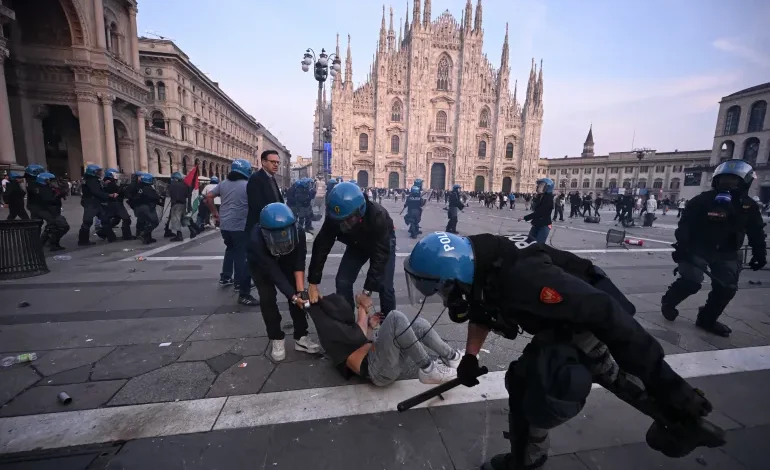

Nearly two months after French high school students first took to the streets over missing teachers, overcrowded classrooms and deteriorating school buildings, the protest movement they helped ignite is no longer just a story about education, or even just about France.
The crowds are smaller than they were at the movement’s October peak, but the pressure has not disappeared. On November 7, France’s Interior Ministry counted 146,000 demonstrators nationwide, including 46,000 in Paris, while unions put the figures at 250,000 and 75,000 respectively. Some 70,000 security personnel were deployed. Most demonstrations were peaceful, although clashes again occurred in Paris, Lyon and elsewhere.
Two days later, Prime Minister Sébastien Lecornu brought forward France’s next minimum-wage increase from January to December in an effort to respond to the cost-of-living anger that has become one of the movement’s central demands. The increase will lift monthly net minimum pay from €1,478 to €1,502. Major unions immediately said it was insufficient, with the CGT calling for another round of protests on November 17.
The trajectory is significant.
What began at French high schools has become a coalition involving students, workers, trade unions and Yellow Vest activists, with grievances extending from education to wages, fuel prices, housing, pensions and public services.
And France increasingly looks like the most visible expression of a much broader European problem.
An Al Jazeera analysis of ACLED data identified more than 1,700 protests and riots involving at least 100 people across 31 European countries between September 15 and October 30. More than 1,200 of those events were recorded in France alone, followed by Spain with 173, Italy with 160, Germany with 70 and Portugal with 33.
Those figures do not mean Paris exported a single organized protest movement across the continent. The national causes differ substantially. But France has become both the epicenter and a reference point for a wave of unrest driven by a strikingly similar collection of pressures: rising living costs, strained public services, unaffordable housing, wage frustration and declining confidence that conventional political institutions can provide credible answers.
Nathalie Tehio, president of France’s Ligue des droits de l’Homme, or LDH, sees the erosion of public services as one of the central links between otherwise different groups of protesters.
“The common reproach is the lack of investment in public services, which makes rights ineffective and exacerbates social inequalities. The high cost of living, particularly the high price of fuel, due to Trump’s war in Iran, is also contributing to the growing anger,” Tehio said in a letter to the Wyoming Star.
Her argument goes beyond a dispute over how much governments spend.
A right to education has limited meaning to a student whose school cannot reliably provide teachers. Social protections feel less substantial when wages fail to keep pace with housing, energy or food costs. And access to public services becomes increasingly unequal when their quality depends on where people live or what alternatives they can personally afford.
That gap between formal rights and lived reality has helped transform narrowly defined national disputes into a broader European political theme.
In Italy, tens of thousands of students and workers joined a nationwide strike on October 30 demanding higher wages and stronger public services while protesting rising living costs. Demonstrations took place in more than 40 cities. Most remained peaceful, though confrontations occurred in Turin, Rome and Milan. Reuters described the Italian rallies as part of a broader wave also affecting France, Spain, Belgium and Albania.
Portugal has faced a parallel housing revolt. Thousands demonstrated outside parliament in Lisbon on October 27 over soaring housing costs and government housing policy. Home prices there have more than doubled since 2017, while new-lease rents have nearly doubled, creating mounting pressure on residents whose wages have not kept pace.
Germany has also seen expanded industrial action linked to cost-of-living pressures, while education and public-service concerns have appeared repeatedly across the continent.
And on November 11, Spain entered an especially significant phase: workers launched the country’s first general strike since 2012.
Spain’s immediate trigger is different from France’s. Housing affordability sits at the center of the Spanish movement. The Bank of Spain estimates a housing shortage of roughly 750,000 homes, while average rent now consumes nearly the entirety of the average monthly salary of a young person. The strike is backed by Spain’s two largest unions as well as tenants’ organizations and follows weeks of demonstrations over rents and evictions.
That distinction matters.
Europe is not witnessing one centrally coordinated French protest reproduced from country to country.
It is witnessing multiple national crises beginning to rhyme.
In France the spark was schools. In Spain it is housing. In Italy it is wages, public services and living costs. In Portugal housing and rents have become a focal point.
What connects them is a growing argument over whether the economic and social institutions Europeans have long relied upon are still delivering enough security to justify confidence in the political systems managing them.
France’s particular importance lies in what happened after its initial grievance expanded.
High school demonstrations did not remain confined to high schools. They created a platform onto which older and broader frustrations could attach themselves. Education became linked to public investment; public investment to inequality; inequality to wages and living costs; and all of those questions eventually to the legitimacy of the government’s response.
ACLED has described the French cycle as exceptional even by the standards of a country famous for street protest. Its data showed demonstrations rising from a five-year average of roughly 20.5 per day to almost 66 per day during the current cycle. Nearly a quarter of recorded events were classified as riots, far above the median for previous protest cycles, although ACLED has also emphasized that many demonstrations remained peaceful and that smaller groups were responsible for violence in major cities.
That mixture of mass peaceful participation and highly visible violence has created a second battle: a struggle over what the protests themselves mean.
Tehio argues that disproportionate attention to clashes and property destruction changes how the entire movement is understood.
“This narrow focus is a problem: it obscures the strength of the protests, the fact that the vast majority of demonstrators marched peacefully, and it causes people to forget the initial social demands. But it also obscures the injuries inflicted on children by the use of extremely dangerous weapons, as well as the push to criminalize (through police custody and prosecutions) ordinary demonstrators.”
Violence during the French unrest has been real. Shops have been looted, buildings damaged and police officers attacked. The unusually high proportion of riots recorded by ACLED distinguishes the current cycle from many previous French mobilizations.
But the policing of the movement has also attracted international scrutiny.
On October 28, United Nations human-rights experts publicly expressed alarm over the French authorities’ response to student protests, including the scale of arrests involving minors and allegations of excessive force.
Source: Getty Images
The question is increasingly relevant beyond France because confrontations over the right to protest are appearing elsewhere alongside the economic grievances themselves.
Police used water cannon against demonstrators during Italy’s October 30 strike. In Spain on November 11, unions accused police of a disproportionate response after clashes with pickets, while authorities confirmed at least one arrest and acknowledged the use of pepper spray during one dispersal operation.
The European protest cycle is therefore becoming about two things at once: the material issues that bring people into the streets and the way governments manage the political conflict once they arrive there.
Tehio argues that France risks making that second problem feed the first.
“Social anger cannot be resolved by security measures. A movement may be temporarily suppressed, but the anger may resurface at a later time, perhaps even more intensely. Repression leads many young people to believe that violence is the best way to assert their rights, since the government does not listen to the unions. This risk polarizes the movements.”
Her warning does not eliminate the state’s responsibility to respond to arson, looting or attacks. It raises a different question: whether treating a broad social movement primarily as a public-order problem can ultimately make its more confrontational elements stronger.
France now provides something close to a European test case.
The government has tried both approaches.
Security deployments have remained enormous, with tens of thousands of officers mobilized on major protest days. At the same time, Lecornu has begun meeting unions and employers and has accelerated the minimum-wage increase — an acknowledgment that policing alone cannot resolve a movement rooted partly in purchasing power and public services.
For Tehio, that political dialogue should have begun much earlier.
“Above all, the government must listen to the unions and engage in dialogue. It has only just agreed to do so, after a month of protests. As for high school students, the government must decide to abolish Parcoursup [the problematic platform where high school students apply for college] and open discussions to better take their preferences into account when making educational choices.:
Those are LDH president Tehio’s prescriptions, and some, particularly abolishing Parcoursup, go considerably beyond the measures the French government has so far offered.
The government’s accelerated minimum-wage increase is a concrete concession, but it remains much smaller than what leading unions are demanding. The CFDT has sought a €100 monthly increase, while the CGT has demanded roughly €150.
That gap helps explain why the movement has survived despite declining turnout.
France has moved from the explosive phase of October 17, when more than half a million people demonstrated and riots produced some of the crisis’s most dramatic images, into something potentially more politically consequential: a prolonged contest over whether protests can force structural concessions.
Europe is watching that contest while confronting versions of the same pressures.
There is no single European movement. A Spanish tenant facing unaffordable rent is not protesting because a French teenager lacks a teacher. An Italian worker demanding higher pay does not automatically share the political agenda of a Yellow Vest demonstrator outside Paris.
But each is confronting a version of the same question: what happens when the institutions expected to provide housing, education, wages, infrastructure or social protection no longer appear capable of keeping pace with the cost and insecurity of ordinary life?
France did not invent that problem.
What it has done is give it one of its largest and most visible stages.
More than 1,700 demonstrations across 31 countries suggest the audience is no longer confined to France.
And as Spain holds its first general strike in 14 years, Italian workers continue mobilizing, Portuguese protesters demand affordable housing and French unions prepare for another confrontation with their government, Europe’s latest protest cycle increasingly looks less like a collection of isolated national episodes than a shared warning expressed in different languages.
The grievances are local.
The pressure behind them is becoming unmistakably European.

The latest news in your social feeds
Subscribe to our social media platforms to stay tuned