
EXCLUSIVE: Armenia Has Ratified TRIPP. Now Comes the Hard Part
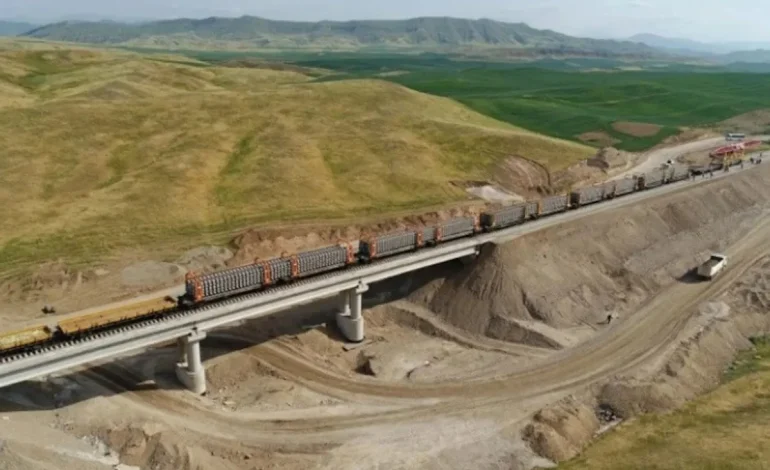



For much of the past year, the Trump Route for International Peace and Prosperity existed somewhere between a peace-process breakthrough, an infrastructure proposal and a geopolitical promise.
That phase is ending.
On October 28, Armenia’s National Assembly ratified the framework agreement with the United States governing TRIPP, the planned multimodal route across southern Armenia that is intended to connect mainland Azerbaijan with its Nakhchivan exclave while giving Armenia new access to regional trade networks. The measure passed by 63 votes to 32. Armenia is set to own 26% of the TRIPP Development Company, while the American side will initially hold a controlling 74% stake for 49 years. If the arrangement is extended for another 50 years, Armenia’s share would rise to 49% without additional investment.
Then, on November 7, Armenia, Azerbaijan and the United States launched trilateral technical planning groups focused initially on transportation and electricity transmission. It was a less dramatic announcement than the White House diplomacy that produced the project, but perhaps a more revealing one. TRIPP is beginning to move from speeches, declarations and political symbolism into the far less glamorous world of engineering, customs rules, land rights, railway ownership, financing and security protocols.
That transition could prove harder than securing the political agreement itself.
The basic geopolitical logic is easy enough to describe. Armenia wants to emerge from decades of regional isolation and become part of east-west transport networks rather than a country bypassed by them. Azerbaijan wants a reliable connection between its mainland and Nakhchivan. Washington sees an opportunity to deepen its role in the South Caucasus, support the Armenia-Azerbaijan peace process and strengthen Trans-Caspian connectivity between Central Asia, the Caucasus, Türkiye and Europe alongside other established regional transport routes.
The official framework repeatedly states that Armenia will retain sovereignty, territorial integrity and jurisdiction over infrastructure on its soil. Armenian authorities are to retain responsibility for border control, customs, security and law enforcement. The agreement also says Armenia can approve infrastructure security arrangements and that any private security personnel would remain subject to Armenian licensing.
Those assurances matter because few infrastructure projects are being built across a more politically sensitive strip of territory.
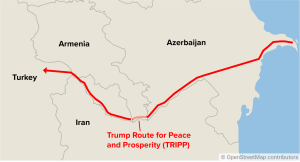
TRIPP would run through Syunik, Armenia’s southern region bordering Iran and lying between mainland Azerbaijan and Nakhchivan. Armenia’s railway network is currently operated under a long-term concession by South Caucasus Railway, a subsidiary of Russian Railways. Iran closely follows any expansion of U.S. involvement near its northern border. Türkiye is essential to the corridor’s eventual commercial logic. Azerbaijan and Armenia are still managing unresolved elements of a peace process that has made significant progress without removing every underlying dispute.
The political architecture is now taking shape. The physical architecture is another matter.
The project has political momentum
Prime Minister Nikol Pashinyan has invested heavily in the idea that connectivity can reinforce Armenia’s sovereignty rather than weaken it.
His government describes TRIPP as part of a broader strategy of reopening regional communications while ensuring that every road, railway and border facility located on Armenian territory remains under Armenian jurisdiction. The framework itself reflects that formula explicitly.
Recent election results have also strengthened Pashinyan’s domestic political position. In October local elections, his Civil Contract party won council majorities in 15 of 19 communities using proportional voting, while an alliance including Civil Contract won majorities in two more. The result did not amount to a referendum specifically on TRIPP, but it reinforced the picture of a governing party that remains capable of winning substantial electoral support as it pursues its current foreign-policy course.
Brian A. Ellison, Professor of Political Science at the American University of Armenia, sees little ambiguity in the government’s commitment.
“Pashinyan and his people are firmly behind TRIPP. It is a reflection of Real Armenia and they are full steam ahead,” he told the Wyoming Star.
That political support substantially lowers one category of risk. Armenia backing away from the project voluntarily now looks far less likely than it did when TRIPP was still an emerging diplomatic formula.
But political commitment does not produce asphalt, rail track or functioning customs systems.
Ellison expects the difficult part to become increasingly visible as implementation moves closer.
“Implementation has been pushed to 2027 for administrative and operational reasons. The structure and charter of the development company that would build the project have yet to be completed. That is an obstacle, but not a critical one. The problem is that there are just lots of problems: the route itself, land ownership issues, and all the stuff it takes to build a big highway,” he said.
That assessment captures the basic paradox surrounding TRIPP at the end of 2026.
The political project is moving quickly. The infrastructure project may not.
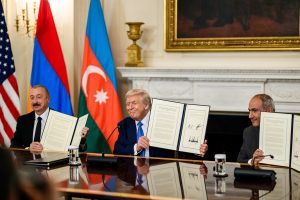
Armenia and the United States still have to finalize the TRIPP Development Company’s charter and shareholders’ agreement. Foreign Minister Ararat Mirzoyan acknowledged during the parliamentary ratification process that those documents remain unfinished. The Armenian government has also been discussing the company’s legal and contractual architecture for months.
The November 7 creation of technical planning groups is evidence of progress, but it is also a reminder of how much remains unresolved. Transportation and electricity transmission alone involve route planning, technical standards, land access, cross-border coordination and integration with existing infrastructure.
The project will eventually have to answer practical questions that no summit declaration can settle.
Who operates particular facilities? What happens when a truck crosses from Azerbaijan into Armenia and then toward Nakhchivan? How much physical inspection occurs? Which digital systems are trusted by all sides? How are emergencies handled? How are disputes between a U.S.-controlled development company and Armenian regulators resolved? Which roads or railways are rehabilitated, and which must be built from scratch?
The agreement provides principles. Implementation requires procedures.
The 74% question
No provision has attracted more scrutiny inside Armenia than the proposed ownership structure.
The United States, through a U.S.-owned entity, is expected to control 74% of the TRIPP Development Company. Armenia would own 26%. The initial arrangement would last 49 years, and an agreed 50-year extension would raise Armenia’s stake to 49%, leaving the American entity with 51%.
Supporters argue that ownership of the development company should not be confused with sovereignty over Armenian territory. The framework places border control, security and jurisdiction explicitly in Armenian hands and gives Armenia veto rights over a range of reserved matters, including changes of control, major concession decisions and national-security issues.
That distinction is legally important.
Politically, however, a foreign government-controlled entity owning nearly three-quarters of a company administering infrastructure across one of Armenia’s most strategically sensitive regions was always going to invite questions.
Ellison does not think the initial structure will necessarily be the final political equilibrium.
“The Armenians are not, in the long run, going to settle for the 74% – 24% split. Armenia wants 49%. The money is not actually there, though the Armenian government says money is not a problem,” he said.
The formal agreement specifies a 74%-26% split rather than the 74%-24% formulation in Ellison’s written comment. It already provides a mechanism under which Armenia could eventually reach 49%, although only if the parties mutually extend the arrangement after the initial 49-year period.
The financing question is more immediate.
The framework establishes institutional control, but it does not itself amount to a fully funded construction program. That distinction will become increasingly important as feasibility studies turn into actual contracts.
Ambassador Richard D. Kauzlarich, former U.S. diplomat and now Co-director of the Center for Energy Science and Policy and Distinguished Visiting Professor at George Mason University’s Schar School, sees significant unanswered questions on the American side.
“The American involvement in the TRIPP is unclear. Who are the private sector parties? What is Türkiye’s role, especially in light of the current differences between Ankara and Baku? Will Trump resume military action against Iran?” he told the Wyoming Star.
According to Kauzlarich, for public the project seems to be at its beginning.
“The midterm election results are likely to result in a call for hearings on possible corruption surrounding the project, and that may slow things down. All of these will likely slow progress in 2027 on all sides,” he added.
The core of his argument is that the project has a state-to-state framework before it has a complete commercial ecosystem.
A development company exists on paper as the institutional center of TRIPP. The actual mix of investors, contractors, operators, insurers and lenders that would turn that framework into a functioning corridor remains less clear.
Large infrastructure projects are routinely announced before every financing layer is in place. That alone is not unusual. TRIPP, however, combines commercial risk with several different forms of geopolitical risk at once.
Existing railway arrangements will shape implementation
One of the most important practical questions concerns Armenia’s existing rail system.
The country owns its railway infrastructure, but since 2008 the network has been operated under a 30-year concession by South Caucasus Railway, a wholly owned subsidiary of Russian Railways. The concession runs through 2038, with a possible extension.
That arrangement predates TRIPP by almost two decades and forms part of the existing legal and operational environment in which any new railway component will have to be developed.
As Armenia explores new transport links involving the United States, Turkey, Azerbaijan and other regional partners, planners will need to clarify how new infrastructure interacts with the current concession, existing technical systems and Armenia’s wider railway network.
Dr. Philip Gamaghelyan, an Associate Professor at the Kroc School of Peace Studies at the University of San Diego, highlights the legal and institutional dimension.
“Armenia faces political and legal challenges in developing roads and rail routes with outside partners. Its railway infrastructure is managed by South Caucasus Railway under a 30-year concession agreement signed in 2008 and running through 2038. This creates challenges for Western investors, both public and private. At the same time, the Armenian government has shown a strong commitment to finding a way forward,” he told the Wyoming Star.
The issue is therefore one of coordination among existing contractual obligations and proposed new investment.
Pashinyan has publicly discussed Armenia’s options regarding the concession and has also indicated a preference for resolving outstanding questions through negotiated arrangements. Various possibilities have been discussed publicly, but no change to the current concession has been finalized.
The railway question exposes something fundamental about TRIPP.
Building a new transport corridor does not mean building on an empty map.
Armenia’s infrastructure reflects decades of regional economic development and existing cross-border arrangements. Any new corridor will have to integrate with that system in legal, technical and commercial terms.
Aghasi Tavadyan, head of the Economic Uncertainty Modelling Laboratory at the Armenian State University of Economics and founder of Data Deltum, in an interview with the Wyoming Star described Armenia’s rail network as effectively an “orphan railway.” His recent analysis notes that of Armenia’s four state borders, only the Georgian border currently has an operating rail crossing, while Armenian rail freight turnover fell 58% between 2022 and 2024.
There is also an engineering problem that geopolitics cannot vote away.
Armenia and other former Soviet railway systems use the 1,520 mm gauge, while Türkiye uses the European-standard 1,435 mm gauge. Any functioning rail connection toward Türkiye therefore requires a break-of-gauge solution, whether through transshipment, adjustable systems or other technical infrastructure.
These details sound mundane compared with peace treaties and great-power competition.
They decide whether freight actually moves.
Iran: a red line that has not disappeared
TRIPP’s southern geography guarantees that Iran will remain part of every serious discussion about the project.
Syunik sits directly along Iran’s northern frontier. Tehran has long emphasized the importance of preserving Armenia’s sovereignty, internationally recognized borders and the existing regional balance, while closely monitoring any potential foreign security presence near its border.
Armenian officials have repeatedly insisted that TRIPP does not alter those principles.
The framework states that Armenia retains sovereignty and responsibility for border and security functions. Pashinyan has publicly said TRIPP “does not imply any foreign military and/or armed presence.” Armenian diplomats have given Tehran the same assurances.
Iran’s position has become more nuanced over the course of 2026.
Iranian Ambassador Khalil Shirgholami said in September that Tehran would have no grounds to oppose the project if two conditions were met: Armenia’s sovereignty and territorial integrity must remain intact, and no U.S. military or security forces should be deployed.
Armenian Foreign Minister Mirzoyan subsequently said Iran’s concerns had been answered and that Tehran was broadly satisfied with the direction of discussions. Iranian officials have nevertheless continued to monitor the project closely, particularly the mechanisms governing any security presence associated with infrastructure operations.
Ellison remains cautious about the regional environment.
“The Iranians will not allow any kind of US security presence. The war creates instability for financing and implementation. From a diplomatic perspective, Iran has enormous influence over Armenia and Azerbaijan,” he said.
That distinction between military presence and private infrastructure security may become particularly sensitive.
The TRIPP agreement permits infrastructure security plans and contemplates the possible use of private security personnel, but places those personnel under Armenian licensing and preserves Armenian authority in emergencies.
Legally, that is very different from stationing U.S. forces.
Politically, Tehran is likely to scrutinize the details rather than rely only on labels.
The wider conflict environment also affects investors even if the route itself remains untouched.
Syuzanna Petrosyan, Editor at Large at CivilNet, argues that the political and institutional advances are real but still far ahead of the project’s security foundation.
“What has been achieved so far is mainly political and institutional. Institutionally, the Armenian parliament has ratified the project. Politically, Civil Contract’s strong election performance signals that Pashinyan retains domestic support to pursue Western-backed initiatives. From the perspective of U.S. officials and investors, it’s important to have those pieces in place,” she said.
Petrosyan has explained that the main question now is whether TRIPP can move from political agreements to a project that investors are actually ready to finance. Security remains a major concern, she noted, pointing to unresolved tensions between Armenia and Azerbaijan, the issue of Armenian prisoners of war and continuing disagreements over a final peace deal.
She added that the war involving Iran creates another layer of uncertainty. Even if Armenia itself is not directly affected, the risk of regional escalation could still make insurers, lenders and contractors more cautious about the project.
Her formulation gets close to TRIPP’s central investment dilemma.
Infrastructure is built over decades. Regional politics can change in days.
An investor looking at a highway, rail line or energy connection in Syunik must calculate not only likely freight volumes but political relations among Armenia, Azerbaijan, Iran, Russia, Türkiye and the United States across the lifetime of the project.
That is a much more difficult spreadsheet.
A peace project before there is a final peace
TRIPP emerged from the Armenia-Azerbaijan normalization process, but that process itself remains incomplete.
The August 2025 Washington declaration established the political basis for opening communications and pursuing the route. Armenia and the United States have since institutionalized the project to an extent that would have seemed improbable only a few years earlier.
Yet disagreements remain.
One particularly sensitive issue concerns Azerbaijan’s demand that Armenia amend constitutional language Baku considers incompatible with a final peace settlement. Pashinyan has said Armenia intends to pursue constitutional reform on its own domestic timetable but will not negotiate its constitution with Azerbaijan.
That matters because transport corridors cannot be insulated entirely from the political relationship around them.
A railway may be commercially viable on paper while remaining difficult to finance if investors believe renewed confrontation could shut it down.
Ellison’s expectation for 2027 is therefore restrained.
“In 2027, at best, the development company becomes operational, and administrative issues, again, like customs and security arrangements, are finalized. Some limited physical progress may be made, but delay is more likely because of regional issues,” he said.
That would still represent meaningful progress.
A functioning development company, agreed customs protocols, engineering studies and finalized security arrangements would move TRIPP much closer to construction than it is today.
But it would be progress measured in institutions rather than kilometers.
That distinction deserves attention because infrastructure diplomacy often creates expectations long before machinery arrives on the ground.
The public has not necessarily bought the promise
Political backing from the Armenian government also should not be confused with a settled social consensus.
TRIPP is marketed as a route capable of increasing trade, reducing isolation and integrating Armenia more deeply into regional commerce. For a landlocked economy with historically limited transport access across several borders, those benefits are potentially significant.
The question is whether Armenian voters believe the promised economic return outweighs the perceived strategic risk.
Ellison sees considerable skepticism.
“Pashinyan is popular, but there is not broad, or even narrow, consensus in Armenian public opinion that TRIPP can deliver on its economic and security promises,” he said.
That skepticism is understandable.
The project requires Armenians to accept a proposition that would have sounded politically extraordinary not long ago: that a route designed in part to facilitate Azerbaijani transit through southern Armenia can simultaneously strengthen Armenian sovereignty and economic security.
The government’s answer is that greater regional connectivity could create economic opportunities of its own.
TRIPP is therefore part infrastructure project, part bet on a different regional order.
If Armenia gains reliable access through Azerbaijani territory to new markets while retaining full jurisdiction over the route through Syunik, the government can argue that connectivity has become reciprocal rather than one-sided.
If the route primarily functions as a connection between Azerbaijan and Nakhchivan while Armenia sees limited commercial benefit, domestic criticism will be much harder to contain.
That is why the design of accompanying rail, road and customs connections matters almost as much as the headline route itself.
Azerbaijan is becoming more commercially important at exactly the right moment
TRIPP is unfolding while Azerbaijan’s economic role is also receiving renewed attention from international energy companies.
That context matters because the corridor’s commercial logic is larger than bilateral traffic between Armenia and Azerbaijan.
In September, SOCAR and ExxonMobil signed a 50-50 production-sharing agreement covering unconventional hydrocarbons in Azerbaijan’s Middle Kura basin, with ExxonMobil as operator. Around the same time, SOCAR, TotalEnergies and Abu Dhabi’s XRG reached a final investment decision on the next phase of the Absheron offshore gas and condensate field. The development could unlock up to 5 trillion cubic feet of recoverable gas, with expanded production expected from 2029.
Azerbaijan already plays a substantial role in European energy diversification, and instability affecting Gulf production and shipping has increased the strategic value of alternative suppliers and transport routes.
Alexandre D. Rovere, a former ExxonMobil executive, former fellow at Harvard University’s Belfer Center for Science and International Affairs and non-resident author at Fondazione Machiavelli, places TRIPP and the wider South Caucasus in that energy-security context.
“The ongoing military conflicts in the Middle East, which have compromised the production and distribution of the Gulf states, have led to increased interest in Azerbaijan’s oil and gas potential. This interest is driven both by the desire to ensure the stability of existing production and export evacuation routes, and by the potential to produce and deliver additional volumes of oil and gas to global markets, as well as to support Europe’s energy security through the diversification of its energy supply sources,” he told the Wyoming Star.
Rovere pointed to two major energy deals signed in September as evidence of Azerbaijan’s growing importance to international investors: ExxonMobil and SOCAR agreed to jointly develop unconventional resources in the Middle Kura basin, while the Absheron gas project moved into full-field development, potentially unlocking up to 5 trillion cubic feet of gas.
At the same time, he noted that Azerbaijan operates in a sensitive regional environment, bordering both Russia and Iran and balancing relationships with neighboring Armenia and Georgia.
In his view, Baku’s long-standing non-aligned approach remains central to managing those risks. By maintaining working relations with its neighbors while attracting foreign investment, Azerbaijan has been able to support large, long-term energy and infrastructure projects.
Rovere’s argument points to the commercial environment in which TRIPP would operate.
The South Caucasus is strategically valuable because it connects several major economic regions and offers multiple potential routes for trade, energy and transport.
That geographic position creates opportunities while also requiring careful coordination among neighboring states and external partners.
The Middle Corridor question
TRIPP’s eventual significance will depend heavily on whether it becomes part of a commercially competitive Trans-Caspian system rather than simply a politically celebrated road between two Azerbaijani territories.
The broader Middle Corridor connects China and Central Asia across the Caspian Sea to the South Caucasus, Türkiye and Europe.
Its importance has increased in recent years as governments and companies have sought greater route diversification across Eurasia and more resilient logistics networks. Armenia has historically sat outside much of that traffic. TRIPP offers a possibility of changing that.
The project’s official objectives include international, interstate and domestic connectivity, regional trade and Armenia’s own access to external markets.
Success therefore cannot simply be measured by whether Azerbaijani cargo crosses Syunik. The more important test for Armenia is whether Armenian exporters and logistics companies gain meaningful access in the other direction. Reciprocity is what could turn a controversial transit arrangement into an economic strategy.
If Armenian businesses can move goods efficiently toward Türkiye and Europe and through Azerbaijan toward Caspian markets, the corridor could reduce the economic cost of Armenia’s landlocked geography.
If bureaucratic barriers remain while Azerbaijani transit receives preferential treatment, domestic perceptions will be very different. Those details belong to the implementation phase that is only now beginning.
The project is farther along than its critics once expected
It is worth recognizing how much has already changed. The South Caucasus spent decades structured around closed borders, unresolved conflicts and competing regional arrangements.
A U.S.-backed development company jointly owned with Armenia, tasked with building infrastructure to support movement between Azerbaijan and Nakhchivan through Armenian territory, would once have sounded more like a diplomatic thought experiment than an imminent policy project.
Today Armenia’s parliament has ratified the framework. Technical teams from Armenia, Azerbaijan and the United States are working together. Engineering and feasibility studies are underway. The ownership formula is written into an interstate agreement.
The government in Yerevan has survived elections while continuing to champion the project. These are not trivial developments. The temptation, though, is to confuse political irreversibility with operational readiness. TRIPP is not yet a functioning corridor.
It does not yet have a completed shareholders’ agreement. Its final commercial participants remain unclear. The relationship between proposed new railway investment and Armenia’s existing concession arrangements has not been fully resolved.
Iran continues to watch the project carefully. Customs and border protocols still require detailed design.
And the security environment between Armenia and Azerbaijan remains sufficiently uncertain that investors will continue pricing political risk into every serious calculation.
Kauzlarich’s description remains apt:
“From what is public, we appear to be at the very beginning of the project.”
What would success in 2027 actually look like?
A realistic assessment of the next year may therefore require lowering expectations about visible construction while raising expectations about institutional progress.
If the TRIPP Development Company becomes legally operational, the shareholders’ agreement is completed, route planning advances, land questions begin to be resolved, customs protocols are agreed and viable financing starts to emerge, 2027 could be a successful year even without a finished road or kilometers of new railway track.
That may sound underwhelming for a project wrapped in the language of historic peace.
Infrastructure does not care about rhetoric.
Ellison’s forecast is deliberately modest:
“In 2027, at best, the development company becomes operational, and administrative issues, again, like customs and security arrangements, are finalized. Some limited physical progress may be made, but delay is more likely because of regional issues.”
The logic behind that caution becomes stronger when all the constraints are placed on the same map.
To the north sits Georgia, Armenia’s existing transport outlet and an important regional transit partner.
To the east and west sit Azerbaijan and Türkiye, whose opening to Armenia could transform the country’s economy but depends on political normalization holding.
To the south sits Iran, supportive of regional connectivity under Armenian sovereignty while attentive to the security implications of new foreign involvement.
Inside Armenia itself, the railway network continues to be operated by South Caucasus Railway, a subsidiary of Russian Railways, under the existing concession framework through 2038.
The United States, meanwhile, has taken a central role in TRIPP’s proposed institutional structure, while the project’s eventual commercial participants and long-term operating model continue to be developed.
That is an unusually dense concentration of legal, commercial and diplomatic considerations for a transport corridor only a few dozen kilometers long in its most strategically discussed section.
A corridor or a new regional architecture?
TRIPP’s importance ultimately lies in the possibility that it becomes more than infrastructure.
Roads and railways shape political choices because they determine who trades with whom, which borders become economically valuable and which countries become connected through new commercial relationships.
For decades, the South Caucasus has lived with restricted connectivity shaped by unresolved political disputes and closed borders.
TRIPP attempts to create another model. Connectivity is supposed to create interests in preserving peace. That theory is plausible. It is not automatic.
Economic interdependence can raise the cost of conflict. It cannot by itself eliminate nationalism, territorial disputes or strategic competition.
This is why Syuzanna Petrosyan’s distinction between political progress and a “structured, financeable, and secure corridor” is so important. TRIPP has crossed the political threshold. Now it has to cross the commercial one.
That means convincing an insurer that the risk is manageable. Convincing a lender that freight volumes justify financing. Convincing Armenia that sovereignty exists in operational practice rather than only treaty language. Convincing Azerbaijan that border procedures will remain efficient.
Convincing Iran that the corridor remains consistent with the stated security framework. Clarifying for investors how new infrastructure will coexist legally and operationally with Armenia’s existing railway concession and technical systems.
And eventually, convincing ordinary Armenians that the route delivers benefits they can see.
The hardest part of TRIPP may have looked like persuading Armenia and Azerbaijan to accept the concept. By the end of 2026, that increasingly looks like only the beginning.
The Armenian parliament has voted. Washington is formally invested. Azerbaijan has a strategic interest in the route. Technical groups are at work, and the agreement now has a legal structure. The next phase will be quieter.
It will take place in company charters, cadastral maps, customs protocols, investment committees, insurance models and negotiations over rail gauges.
Those details rarely produce historic photographs. They will decide whether TRIPP becomes one.

The latest news in your social feeds
Subscribe to our social media platforms to stay tuned