
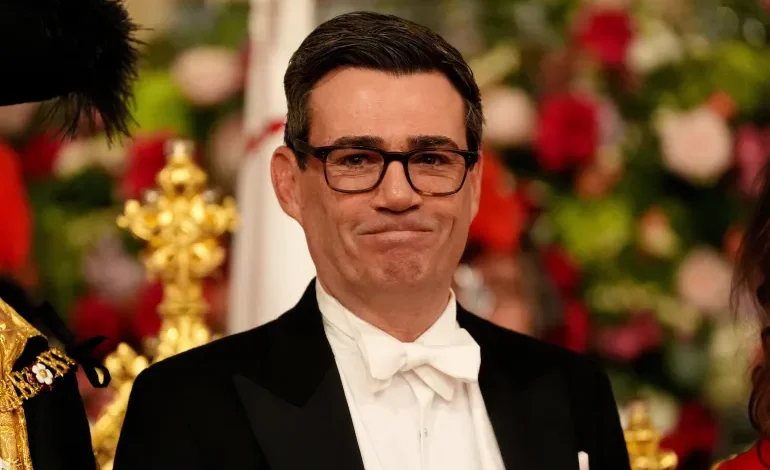

British Prime Minister Andy Burnham has said Brexit failed to deliver what voters were promised and argued that the UK now needs to reset its relationship with the European Union as global politics becomes more fragmented.
Speaking at the Lord Mayor’s Banquet in London on Monday, Burnham compared the aftermath of Britain’s departure from the EU with Hans Christian Andersen’s “The Emperor’s New Clothes”, a story in which those around a ruler refuse to acknowledge an obvious reality.
“I do try to say things as I see them,” Burnham said. “And to be frank, we have lost more than we have gained in the last 10 years. The hard Brexit we were given is not good enough for Britain.”
His remarks came ahead of a UK-EU summit in Brussels on Friday, where the government hopes to make progress on a series of practical agreements with the 27-member bloc.
Burnham said the talks could deliver “real improvements in people’s everyday lives in areas of the country that have felt neglected for too long”.
Any agreement, he said, would need to meet three tests: remain consistent with Labour’s manifesto and red lines, improve the current Brexit settlement in a way that reflects the 2016 vote, and pass what he calls the Makerfield Test, his benchmark for whether policy changes deliver tangible benefits to neglected communities.
The summit is expected to focus on easing trade in food and drink, cooperation on energy and emissions, and a scheme allowing young people to live and work for limited periods in the UK and EU.
The meeting forms part of Burnham’s wider attempt to rebuild relations with Brussels a decade after the referendum and six years after Britain formally left the bloc.
Burnham said one of the central promises of the Leave campaign — that Britain would “take back control” of its borders, laws and economy — had not been fulfilled.
Trade with EU countries has fallen sharply since Brexit, while estimates of the economic cost range from 4 percent to 8 percent of UK gross domestic product, he said.
Burnham, Britain’s seventh prime minister since the 2016 referendum, argued that the country’s experience over the past decade could now give it a role in rebuilding international cooperation.
He said the government would begin a broader conversation with EU partners about Britain’s long-term relationship with the bloc after the Brussels summit.
His spokesperson, Tom Wells, said on Monday that “no assumptions are being made” and “the British public will be the boss of any outcome”.
For now, Burnham remains constrained by the policy inherited from his predecessor, Keir Starmer.
Starmer had pledged that Britain would not rejoin either the EU customs union or the single market, and Burnham is expected to remain within those limits until the next national election.
Any move beyond them would reopen one of the country’s most divisive political questions.
The 2016 referendum produced a narrow result, with 52 percent voting to leave the EU and 48 percent voting to remain.
The latest news in your social feeds
Subscribe to our social media platforms to stay tuned