
EXCLUSIVE: COP31’s ‘35 by 35’ Target Has Grid Problem
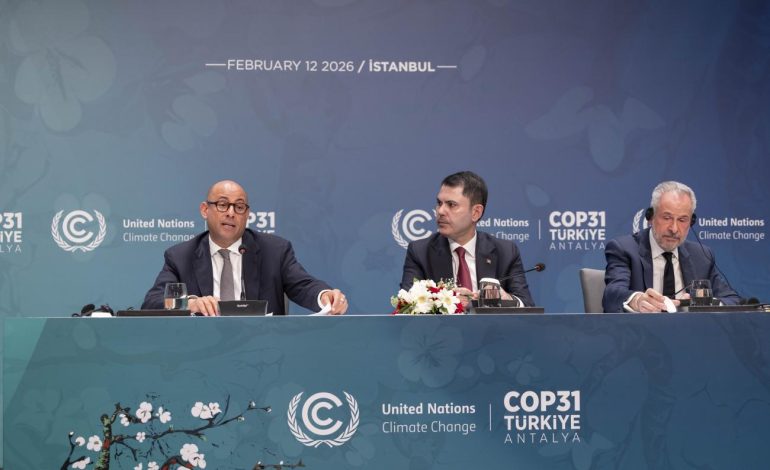


A new country-by-country analysis finds that electrifying cars, heating and industry could deliver radically different climate results depending on what generates the extra power. Greenly CEO Alexis Normand says clean electricity and electrification must be treated as one policy, not two.
COP31 has put a deceptively simple number at the center of its energy agenda: 35%.
The “35 by 35” initiative aims to raise electricity’s share of global final energy consumption to 35% by 2035, accelerating the replacement of fossil-fuel technologies with electric vehicles, heat pumps and industrial equipment.
The attraction is obvious. Electric technologies are often substantially more efficient than combustion-based alternatives, meaning the same transport, heating or industrial service can require less overall energy.
But a new analysis from the Greenly Carbon Institute argues that the headline number leaves out an equally important question: what will generate all that additional electricity?
Across the OECD, electricity accounted for 25.1% of final energy use in 2023, according to Greenly’s study. Thirty-four of 38 OECD economies remained below the proposed 35% benchmark.
Getting those countries to the target would mean replacing the equivalent of about 6,500 terawatt-hours of annual oil, gas and coal consumption while supplying roughly 2,400 TWh of additional electricity.
That shift could substantially reduce emissions. Or, on a sufficiently carbon-intensive grid, much of the theoretical benefit could disappear.
Alexis Normand, CEO of Greenly, told the Wyoming Star that the clean-power side of the equation should therefore be built directly into the way the COP31 target is implemented.
“Absolutely. Clean-power expansion must be built into how the target is implemented and assessed, not treated as an unrelated promise,” Normand said.
That would make the target harder, particularly for countries starting with more carbon-intensive electricity systems. Normand said the overall electrification objective could remain common while allowing countries more flexibility in how they clean up their individual power mixes.
The distinction matters because electrification measures an energy pathway, not automatically an emissions outcome.
A gasoline car replaced by an electric vehicle no longer burns gasoline on the road. A heat pump replacing a gas boiler eliminates combustion inside the building. But the electricity powering either technology still has to come from somewhere.
If new demand is supplied largely by low-carbon generation, most of the emissions benefit survives. If additional electricity comes largely from high-emitting generation, the result can look very different.
As Normand put it, governments need to track “both sides together: how much oil, gas and coal are displaced, and what supplies the additional electricity.”
Without that second measure, he warned:
“35% could become a measure of how much energy runs through a wire, rather than how much CO₂ we have actually avoided.”
One target, very different energy systems
Greenly’s country comparison illustrates why a single global percentage can conceal dramatically different starting points.
Some economies already have relatively clean electricity but still use comparatively little electricity across transport, buildings and other final-energy applications. In countries such as France, Sweden, Switzerland, Austria and Denmark, the principal challenge is therefore increasing electrification itself.
For those systems, moving a car, boiler or industrial process onto the grid can preserve a large share of the theoretical emissions reduction because the electricity is already produced with relatively low carbon intensity.
Other economies sit much closer to the 35% electrification benchmark but still rely heavily on carbon-intensive power.
Japan, for example, was already at 33.6% electricity in final energy use in Greenly’s 2023 dataset, but only 29.8% of its electricity generation was categorized as low-carbon.
Poland faced a different combination: electricity represented only 16.7% of final energy use, while low-carbon sources accounted for 27.7% of generation.
Then there are large economies that face both problems at once, increasing the amount of the economy that runs on electricity while simultaneously building enough lower-carbon generation and infrastructure to supply it.
Greenly places Germany and the United States among that group.
The result is that the same nominal progress toward 35% does not produce the same climate outcome in every country.
According to the institute’s modelling, France would retain about 92% of the theoretical CO₂-equivalent saving from the modeled conversions using its 2023 grid mix. Poland would retain only around 3%.
Germany and the United States would preserve roughly 41%, while Japan would capture about 14%.
The exercise is not a forecast of what those countries’ grids will look like in 2035. It is designed instead to show what happens if electrification advances while the carbon intensity of electricity remains around its recent level.
When Greenly reruns the conversions using additional low-carbon electricity at 50 grams of CO₂-equivalent per kilowatt-hour, the picture changes sharply: every economy in the analysis preserves roughly 90% or more of the potential emissions benefit.
That is why Normand argues that the investment plan behind 35 by 35 matters as much as the percentage itself.
“A country should be able to show a credible plan for clean generation and grid capacity alongside its plan for vehicles, heating and industry,” he said.
The bottleneck may be the system behind the plug
Electrification discussions often focus on consumer technologies: how quickly households can replace combustion vehicles, how many heat pumps can be installed or how rapidly factories can switch equipment.
Greenly’s analysis suggests that supply-side infrastructure could prove just as difficult.
Germany, under the modeled pathway, would need to replace roughly 13 million boilers by 2035, or around 1.3 million per year.
The United States would face an even larger equipment transition, including an estimated 49 million boilers in the modeled scenario.
But replacing equipment is only half the engineering problem.
More electric cars, heating systems and factories mean more generating capacity, stronger transmission and distribution networks, storage, permitting, grid connections and financing.
Normand said that while households and businesses can already have strong economic reasons to electrify, those decisions depend on infrastructure that private consumers cannot build themselves.
Public policy, he argued, has an important role in enabling generation, storage and transmission because major energy projects require significant capital, permits and long planning horizons.
“Institutional stability is key to encourage project financing,” he said.
The United States is not participating at the federal level in COP31 this year, but Greenly includes it in the OECD comparison because its scale makes it particularly useful for understanding the infrastructure challenge.
In the institute’s modeled pathway, the U.S. road transport, building and industrial conversions examined in the study would create roughly 1,169 TWh of additional annual electricity demand by 2035.
That is almost half of the 2,400 TWh of additional power Greenly estimates would be needed across the 34 OECD economies currently below the 35% benchmark.
Normand argues that the problem should therefore not be reduced to a choice between replacing equipment and cleaning the grid.
“Greenly’s study illustrates why there is no single answer,” he said.
Japan, Poland and the United States face different combinations of electricity demand, grid carbon intensity, infrastructure and equipment turnover. Their routes toward the same headline target would consequently require different investment priorities.
“These are different bottlenecks, not one problem with one fix,” Normand said.
China shows the risk of measuring the wrong thing
China provides the clearest illustration in Greenly’s study of why electrification and decarbonization cannot automatically be treated as synonyms.
In one modeled scenario, applying China’s 2023 average grid emissions intensity to the additional electricity demand created by electrification causes overall emissions to rise rather than fall.
Normand stresses that the result should not be read as a projection of China’s electricity system in 2035. The calculation deliberately holds the grid emissions factor at its 2023 level to test the consequences of electrifying demand without simultaneously changing how electricity is supplied.
“China shows why an electrification percentage is not, by itself, an emissions metric,” he said.
The physical logic is relatively straightforward.
Electrification removes fuel consumption where an activity occurs. But whether it reduces emissions across the full energy system depends on three variables: what fossil fuel is displaced, how efficiently the new electric technology operates and what type of generation responds to the added electricity demand.
For policymakers, Normand argues that this means the headline electrification percentage needs companion metrics.
Governments should report how much fossil-fuel use has actually been displaced, how much new electricity demand has been created and the emissions intensity of the electricity serving that demand.
They should also stress-test the result against less favorable scenarios, including cases in which extra consumption is met by additional fossil-fuel generation rather than new low-carbon supply.
“A headline target is useful for mobilizing investment, but those are the numbers that tell us whether it is working for the climate,” Normand said.
Efficiency is still the prize
None of that makes electrification irrelevant to emissions reduction.
One of its most powerful features is that electric technologies can often provide the same service using considerably less energy.

In Greenly’s global scenario, 7.7 units of electricity replace 17.2 units of fossil fuel. That translates into roughly 9.5% less total energy use for the same modeled services.
Electric motors convert a larger share of their energy into movement than combustion engines, while heat pumps move heat rather than creating it primarily through combustion.
That efficiency advantage is one reason electrification has become increasingly central to climate policy.
But it also makes the source of electricity more important. A rapid shift toward electric vehicles and heating can create substantial new demand in a relatively short period, meaning generation and grids have to expand fast enough to prevent the system from leaning more heavily on high-emitting marginal power sources.
The challenge is therefore chronological as much as technological.
Building clean generation several years after electric demand has surged is not equivalent to building the two together.
For the 35 by 35 target to deliver its intended emissions reductions, Greenly recommends that clean generation grow faster than electricity demand, while transmission, permitting, storage and firm capacity develop on a comparable timetable.
That turns what sounds like a consumer electrification target into something much larger: an infrastructure strategy.
COP31’s number needs a second number
The broader climate backdrop explains why Antalya is looking for policies capable of moving faster.
The latest UN emissions assessment says full implementation of current national climate commitments would reduce global emissions by only 11% to 15% between 2025 and 2035. A pathway that limits the scale of the expected temperature overshoot and eventually returns warming toward 1.5 degrees Celsius would require a 45% reduction by 2035.
Against that gap, a concrete electrification goal has obvious appeal. Governments can count electric vehicles, heat pumps, electricity consumption and generating capacity more easily than they can measure abstract promises about long-term transformation.
But Greenly’s analysis suggests that simplicity can become misleading if the target is treated in isolation.
A country moving rapidly from 25% to 35% electrification on an increasingly low-carbon grid is undertaking a very different climate transition from a country reaching the same percentage while adding high-emitting generation to meet the new demand.
Both can report 35%.
Only one metric tells policymakers how much of the economy has moved onto electricity. The other tells them whether doing so actually reduced emissions.
For Normand, COP31 does not need to abandon the headline target. It needs to make the target harder to misunderstand.
“The global target can be shared,” he said. “The investment plans need to reflect each country’s starting point.”
That may ultimately be the most important qualification attached to 35 by 35.
Electrification can make vehicles, homes and industry more efficient. It can shift economies away from direct fuel combustion and create new options for cleaner energy.
But the wire itself is not the climate policy. What matters is what is flowing through it.



The latest news in your social feeds
Subscribe to our social media platforms to stay tuned