
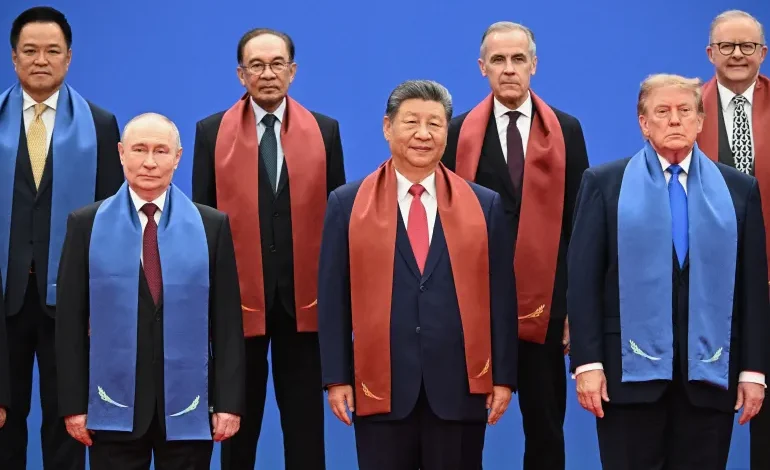

US President Donald Trump, Chinese President Xi Jinping and Russian President Vladimir Putin are set to hold their first-ever three-way meeting on Thursday in Shenzhen, bringing together the leaders of the world’s three most powerful militaries on the sidelines of the Asia-Pacific Economic Cooperation summit.
The meeting has already drawn comparisons with the 1945 Yalta Conference, where the United States, United Kingdom and Soviet Union discussed the shape of the post-war order. But the context today is very different, and analysts caution against assuming that the Shenzhen talks will produce a similarly sweeping geopolitical arrangement.
Instead, the summit is likely to revolve around a handful of practical issues where Washington, Beijing and Moscow have overlapping interests.
The White House has said Trump wants to discuss the war with Iran as well as the possibility of a three-way agreement on nuclear arms. Ukraine is not expected to be formally on the agenda, with Xi understood to view it primarily as a European issue.
Trump arrived in Shenzhen on Wednesday after attending the ASEAN summit in Manila. Xi greeted him at the airport ahead of their third in-person meeting since Washington and Beijing paused their trade dispute late last year.
Relations between the US and China remain complicated despite that pause.
At the height of their trade confrontation, US tariffs on Chinese goods reached 145 percent, while China responded with tariffs of up to 125 percent on American products. A temporary truce agreed in Busan in October 2025 eased some of those measures, and the arrangement has since been extended until January 10, 2027 to allow broader negotiations to continue.
Technology remains another major point of negotiation.
Washington has restricted Chinese access to some advanced US technologies, while Beijing has significant leverage through its position in rare earth minerals. Recent controversies involving semiconductor exports have added another layer to the relationship, although Beijing has rejected spying allegations as “baseless”, and Trump has said he does not intend to raise that issue during the summit.
For Washington, the meeting also comes after renewed diplomatic activity with Moscow.
Trump’s envoys Steve Witkoff and Jared Kushner recently helped facilitate direct Russia-Ukraine talks in Abu Dhabi and have travelled between Kyiv and Moscow as part of that effort.
Days before their latest visit to Moscow, Trump said Washington and Moscow were close to a “big, beautiful agreement” covering not only Ukraine but “all of Europe”.
Trump has increasingly emphasised the possibility of reaching a broader settlement with Russia, while also criticising Ukrainian strikes on Russian energy facilities because of their effect on global oil and diesel prices.
One possible subject in Shenzhen is nuclear arms control.
The New Strategic Arms Reduction Treaty, or New START, between Russia and the United States expired in February. Signed in 2010, the treaty limited the strategic nuclear arsenals of both countries.
Trump has previously called for a “new, improved and modernised” agreement that would also include China, although Beijing has shown little enthusiasm for joining a framework it did not originally negotiate.
China and Russia, meanwhile, arrive at the summit with a relationship that has expanded substantially in recent years.
China is now Russia’s largest trading partner, and Xi and Putin signed more than 40 cooperation agreements at a summit in Beijing in May.
Energy ties have also continued to grow, with Russian oil exports to China rising 35 percent in the first quarter of 2026, according to a Kremlin aide.
Xi and Putin met separately in Shenzhen on Wednesday, where the Chinese president called on the two countries to “lead and advance the trend towards a multipolar world”.
Putin later addressed the APEC summit and spoke about the changing balance of power in the international system.
For Moscow, the trilateral talks offer another opportunity to discuss Ukraine, European security and the future of relations with Washington.
Russia has consistently pushed for a broader conversation about Europe’s security architecture, while the Trump administration has increasingly signalled interest in exploring a negotiated framework that goes beyond immediate battlefield questions.
For Xi, the summit fits into a much longer-term strategy.
China wants room to pursue its economic, technological and regional priorities without another escalation in trade tensions with Washington.
Vuksanovic described China as a rising power that remains focused heavily on internal reform.
“They actually much rather prefer to be patient and to think long term, rather than to go for anything which is diplomatically grandiose,” he said.
Beijing is also positioning itself as a defender of economic stability and multipolar diplomacy at a time when global trade and security relationships are shifting.
That makes the optics of Thursday’s meeting significant even if no major agreement emerges immediately.
For Trump, the gathering offers a chance to demonstrate that Washington remains central to negotiations involving both Beijing and Moscow.
For Xi, it reinforces China’s status as a host and major diplomatic player in the Asia-Pacific.
And for Putin, it provides another high-level forum for direct engagement with both the US and China on questions ranging from security to energy and global economic cooperation.
The rest of the world will be watching primarily for signs of stability.
Governments across Europe, the Gulf and the Global South have strong interests in avoiding renewed trade disruption, reducing geopolitical uncertainty and keeping major powers talking.
“They will primarily observe whether there is any tangible outcome which impacts their own respective interests,” Vuksanovic said, pointing to conflict resolution, the global economy, energy and emerging technologies.
That may ultimately be the most realistic measure of the Shenzhen summit.
Rather than producing a grand new world order, the meeting gives Washington, Beijing and Moscow a rare opportunity to test where cooperation is possible, on nuclear arms, trade, energy and diplomacy, at a moment when all three governments have reasons to keep channels open.

The latest news in your social feeds
Subscribe to our social media platforms to stay tuned