
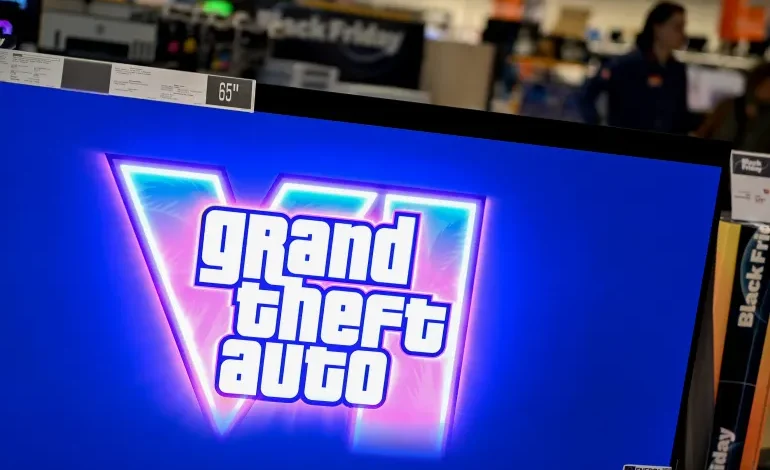

Even before its release, Grand Theft Auto VI had become more than just a video game.
The latest instalment in Rockstar Games’ blockbuster franchise generated more than $1.5bn in pre-sales ahead of Thursday’s launch, capping more than 13 years of anticipation and reinforcing just how central gaming has become to the US entertainment industry.
“The launch of GTA VI is a reminder that games aren’t just niche entertainment—they’re now at the centre of global culture,” Mark DeLoura, Vice President of Strategy for GDC Festival of Gaming, told Al Jazeera.
The game follows Jason and Lucia through Vice City, a fictionalised version of Miami, mixing crime, satire and the sprawling open-world design that has defined the series.
Early reviews have been overwhelmingly positive, with critics praising the game’s scale, detail and storytelling.
Part of that reception reflects the unusual cultural weight the franchise has accumulated.
For players who grew up with earlier versions of Grand Theft Auto, the series carries a strong sense of nostalgia. It is also known for meticulously built environments, distinctive soundtracks and the freedom to behave in ways that would be unthinkable outside a game.
That rebellious appeal once made GTA an easy target.
Earlier entries regularly sparked warnings from parents, television commentators and politicians who argued that violent games could encourage real-world antisocial behaviour.
Some critics are still making that case.
“I really am going to say I’m not thinking this is a good thing for our culture and society,” one participant on a recent Fox News programme said.
Republican Representative Tim Burchett also criticised the game.
“They’ll have a documentary on how best to steal a car at gunpoint or shoot a cop,” he told TMZ. “I mean, what in the world!”
But the wider cultural conversation has shifted dramatically.
Video games that were once treated as a fringe subculture are now routinely incorporated into mainstream advertising, politics, military recruitment and media campaigns.
Even the US military has joined in.
Military outlet Task and Purpose reported that 43 soldiers used a reenlistment incentive that gave them a four-day weekend timed around GTA VI’s release.
The franchise’s reputation has also evolved.
Some critics now focus less on its violence and more on its satire, social commentary and ability to reflect aspects of American life, including inequality and the experiences of immigrants and minorities.
“When a release like this becomes a major cultural event in the US and a shared global conversation, it says a lot about both the scale of the games industry and the place games now hold in people’s lives,” DeLoura said.
The numbers help explain why.
According to the Entertainment Software Association, roughly two-thirds of people in the US play video games.
The industry generated more than $95bn in economic activity in 2025, while US consumers spent more than $60bn on games.
By comparison, the North American box office generated just under $9bn from movie ticket sales in 2025.
That gap underlines a broader shift in entertainment spending, with gaming increasingly competing not just with film but with television, music and social media for time, money and cultural attention.
Yet GTA VI’s extraordinary launch comes during a difficult period for much of the industry.
Studios are wrestling with rising development costs, slower growth and widespread layoffs following years of expansion during the COVID-19 pandemic.
“The industry hired for a pandemic that ended. Demand stopped growing in 2022, costs didn’t, and the average blockbuster now costs $440m, up from $47m in 2000,” Joost van Dreunen, an adjunct assistant professor at NYU Stern and author of the SuperJoost Playlist newsletter, told Al Jazeera.
“GTA VI proves that the model works for exactly one company,” he added.
Rockstar reportedly spent around $1bn developing the game and relied on thousands of employees to achieve a level of scale and detail that few competitors could realistically match.
According to Gaming Layoffs, 40 video game studios have closed in 2026, while nearly 13,000 workers have lost their jobs.
That represents an increase of almost 150 percent compared with the same period last year.
Job insecurity has spread across the sector.
A 2026 GDC Festival of Gaming survey found that about 39 percent of US respondents working in the industry had been laid off at least once during the previous two years.
That creates a striking contrast.
GTA VI may be one of the biggest entertainment launches ever, but its success does not necessarily mean the broader gaming business is healthy.
If anything, its scale shows both sides of the modern industry at once: games have become one of the most powerful forces in global culture, while the cost of producing the biggest titles has made blockbuster success harder than ever to replicate.



The latest news in your social feeds
Subscribe to our social media platforms to stay tuned