
Trump, Xi and Putin issue joint declaration after Shenzhen summit
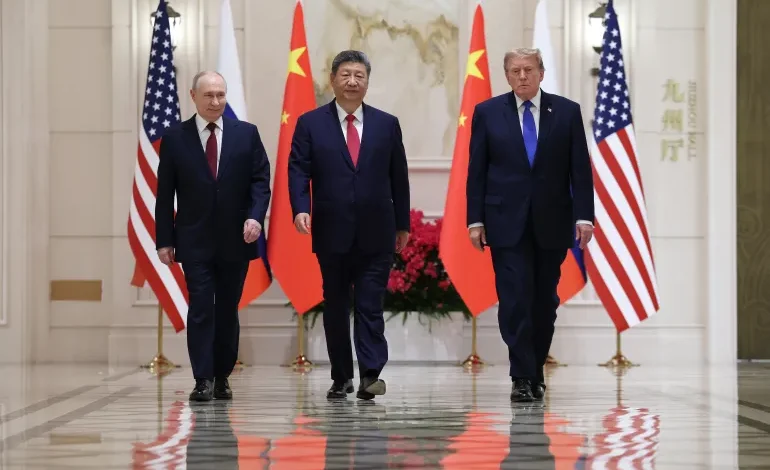

The leaders of the United States, China and Russia have pledged to work more closely on energy security, nuclear risks and broader global stability after holding an unprecedented three-way summit in Shenzhen.
US President Donald Trump, Chinese President Xi Jinping and Russian President Vladimir Putin met on Thursday on the sidelines of the Asia-Pacific Economic Cooperation summit, capping several days of intensive diplomacy across the region.
Xi chaired the more than hour-long meeting after separate bilateral talks among the three leaders.
At the end of the summit, they released what they described as a “peace declaration”, outlining areas where Washington, Beijing and Moscow said they were prepared to cooperate despite major differences elsewhere.
Trump described the talks as a historic gathering between “three of the world’s largest nations” and noted that the countries also possess the world’s three largest nuclear arsenals.
“We’re making history,” he said in his opening remarks.
The US president argued that dialogue between rival powers was essential.
He said “too often past leaders avoided talking to leaders they had disagreements with,” adding, “No peace [was] ever forged by declining opportunities.”
Xi called on the three countries to move beyond a “Cold War mentality” and build a more cooperative relationship.
Putin echoed the broader message of cooperation, arguing that constructive engagement among the three powers could strengthen global stability.
One of the clearest areas of agreement was energy.
According to Chinese state media, the joint declaration reaffirmed the importance of keeping global energy flows stable.
Energy markets have faced sustained pressure this year amid conflict in the Middle East and disruptions affecting Russian energy infrastructure.
The summit did not produce detailed mechanisms for how the three governments intend to stabilise supplies, but the commitment signalled a shared interest in reducing volatility.
The war on Iran was not directly discussed in detail during the trilateral session, although Trump reiterated that Tehran should not acquire nuclear weapons.
Ukraine was also not described as a central topic of the three-way meeting, according to the Kremlin, though it featured prominently in Putin’s separate talks with Trump.
Trump also said he had encouraged Xi to play a role in efforts to resolve the conflict.
Nuclear policy was another major focus.
Before the meeting, Xi said:
“Nuclear weapons should be comprehensively banned and thoroughly destroyed, building a nuclear-free world.
“Nuclear war cannot be won and must not be fought; every effort must be made to prevent it,” he added.
That position was reflected in the joint declaration, with the three countries pledging to open dialogue on reducing nuclear risks, preventing proliferation and maintaining strategic stability.
Trump said the “three countries are uniquely positioned to discuss nuclear weapons” because of the size of their respective arsenals.
He also said Xi agreed with him that the Strait of Hormuz should remain open and that Iran should not be allowed to develop nuclear weapons.
Tehran has repeatedly said its nuclear programme is intended for civilian purposes.
The summit also raised questions about whether more regular trilateral coordination could emerge between Washington, Beijing and Moscow.
Next month, Trump is due to host the G20 summit in Miami, where Xi is expected to attend.
Russia is also a G20 member, and Trump has invited Putin to the gathering.
Putin said after the Shenzhen talks that “The discussion at the trilateral summit was very frank and helped the leaders to better understand one another.”
The three leaders also used their declaration to criticise the International Criminal Court.
They called on the ICC and “similar institutions” not to “abuse their positions”.
None of the three countries is a member of the court.
The United States has had longstanding disagreements with the ICC, particularly over investigations involving US personnel and the court’s actions concerning Israel.
Russia has also strongly criticised the court following the issuance of an arrest warrant for Putin.
China, meanwhile, has repeatedly raised concerns about international judicial bodies intervening in the affairs of sovereign states.
The Shenzhen meeting did not produce sweeping new treaties or detailed agreements, but it established a framework for further dialogue among three major powers on nuclear security, energy and broader geopolitical stability.
Whether that develops into more regular coordination will become clearer in the months ahead.

The latest news in your social feeds
Subscribe to our social media platforms to stay tuned