
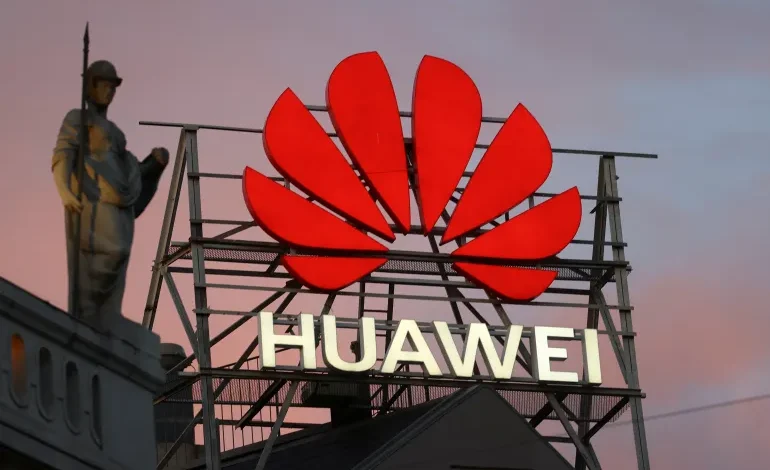

A US jury has convicted Chinese technology giant Huawei Technologies of conspiracy to steal trade secrets and bank fraud after a lengthy federal trial focused on the company’s rise into one of the world’s biggest telecommunications equipment suppliers.
Jurors on Tuesday, however, acquitted Huawei of the most serious charge it faced: racketeering conspiracy.
Prosecutors had used the racketeering charge, more commonly associated with organised crime cases, to argue that Huawei operated through a broad, coordinated effort to obtain intellectual property from US companies.
The mixed verdict followed more than two months of testimony.
US prosecutors called more than 60 witnesses, while the defence presented 15.
Huawei and three affiliated companies faced 12 charges, including racketeering conspiracy, bank fraud, wire fraud, sanctions violations, conspiracy to steal trade secrets and obstruction of justice.
Prosecutors argued that Huawei repeatedly obtained proprietary technology from competitors and business partners in the US and elsewhere.
They also accused the company of misleading banks and US officials about its business activities in countries subject to US sanctions, including Iran and North Korea.
Huawei has been a focus of US government scrutiny for years.
The criminal case began in 2018, and Washington placed the company on a trade blacklist the following year, restricting its access to US technology.
Despite those measures, Huawei has continued to expand in other areas and has become an important player in China’s artificial intelligence and technology sectors.
Huawei’s lawyers argued during the trial that prosecutors had taken isolated incidents involving a small number of employees and used them to construct a misleading picture of a company-wide conspiracy.
Defence lawyer Brian Heberlig said Huawei would appeal the convictions.
At the same time, he described the acquittal on the racketeering charge as a significant result for the company.
“That was the only count that brought all of the allegations together,” Heberlig said outside court.
He said the jury’s decision “repudiated the central government narrative in the case”.
The verdict’s effect on Huawei’s wider business remains uncertain.
The company has already been barred from selling equipment to US carriers for years because of national security concerns and has faced similar restrictions in countries including Canada and the United Kingdom.
The case has its roots in the 2018 detention of Huawei chief financial officer Meng Wanzhou in Canada on a US warrant.
Meng, the daughter of Huawei founder Ren Zhengfei, had been accused of misleading an HSBC banker about the company’s business dealings in Iran.
She fought extradition to the US for nearly three years before reaching a deferred prosecution agreement and returning to China.
The charges against her were later dropped.
The original indictment alleged that Huawei misled HSBC, Standard Chartered and BNP Paribas about its business activities in Iran.
US prosecutors expanded the case in 2020, adding allegations that Huawei had conspired over two decades to steal trade secrets from US technology companies.
During the trial, prosecutors presented several examples they said illustrated that pattern.
They accused Huawei of obtaining router source code from Cisco Systems, taking antenna technology from wireless telecommunications company Quintel and hiring a professor in an effort to gain access to a circuit board developed by semiconductor company CNEX.
Jurors were also shown a video that prosecutors said depicted a Huawei employee placing part of a T-Mobile testing robot into a backpack.
They also heard allegations that a Huawei engineer entered a Fujitsu booth at a trade show and photographed a device.
Prosecutors additionally introduced a statement attached to Meng’s deferred prosecution agreement, in which she acknowledged facts relating to Huawei’s business in Iran.
Meng did not testify during the trial, although an HSBC banker who met with her in 2013 did.
Huawei’s defence disputed the government’s interpretation of the evidence.
Lawyers argued that HSBC and other banks were aware of Huawei’s activities in Iran and continued competing for its business.
During closing arguments, Heberlig accused prosecutors of “cherry-picked” incidents that did not establish a single, 20-year conspiracy.
He said Huawei’s growth came through “hard work, innovation, and investment in research and development”.
Huawei employs more than 200,000 people and operates in about 170 countries.
The verdict leaves both sides with something to point to: prosecutors secured convictions on several major charges, while Huawei avoided the sweeping racketeering finding that would have tied the government’s allegations together into a single criminal enterprise.
The latest news in your social feeds
Subscribe to our social media platforms to stay tuned