
Syria’s Assad Ruling Falls: Former Al-Qaeda Commander, Poised to Lead

Reuters, BBC, and Brookings contributed to this report.
The Assad dynasty is over. Syrian rebels seized Damascus on Sunday after a lightning advance that sent President Bashar al-Assad fleeing to Russia. It’s one of the biggest turning points the Middle East has seen in generations. Six decades of brutal family rule. Thirteen years of civil war. All of it collapsing in a matter of days.
The rebels entered the capital with no sign of army deployments. Thousands of people flooded a main square, waving and chanting “Freedom.” They walked inside the presidential palace. Some left carrying furniture. A motorcycle was parked on the gilded parquet floor of a grand hall. The notorious Sednaya prison – where countless political prisoners were held – was blasted open. Bewildered and elated inmates poured out. Families wept. Newly freed prisoners ran through the streets holding up fingers to show how many years they’d been locked away.
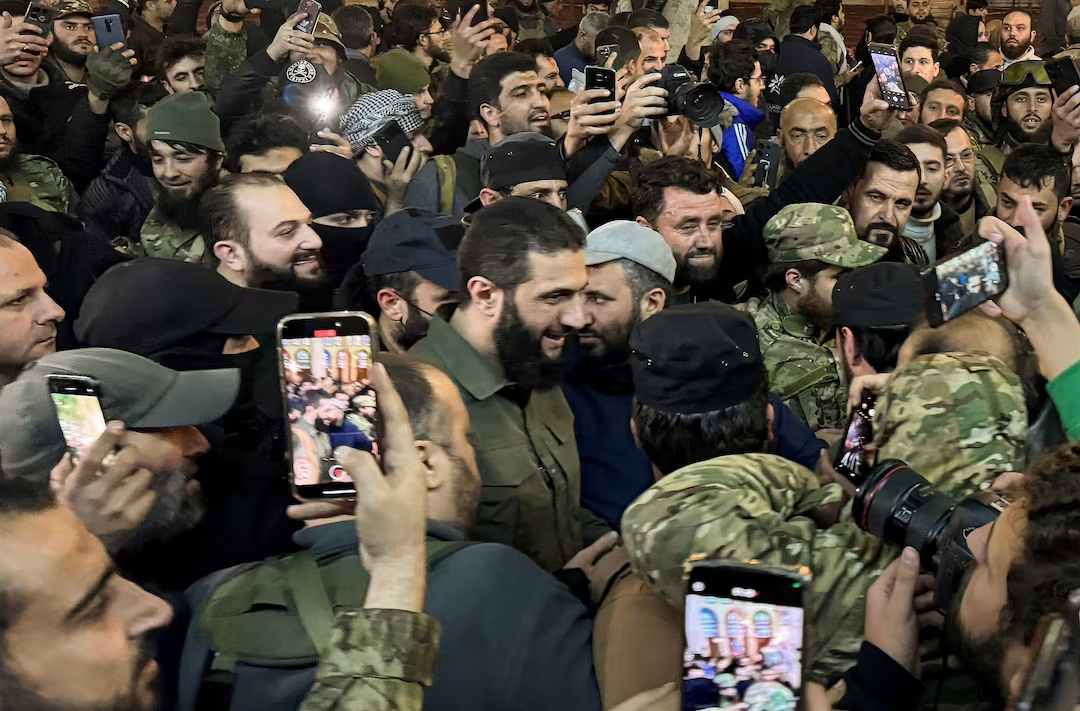
Top rebel commander Abu Mohammed al-Golani addressed a huge crowd at the Umayyad Mosque.
“How many people were displaced across the world? How many people lived in tents? How many drowned in the seas?” he asked, referring to refugees who died trying to reach Europe. “A new history, my brothers, is being written in the entire region after this great victory.”
He promised Syria would become “a beacon for the Islamic nation.”
The speed of the collapse stunned everyone. Russia, which intervened in 2015 to save Assad, was too stretched by its war in Ukraine to help. Iran and Hezbollah, Assad’s other key backers, had been decimated by Israel’s campaign in Lebanon. The front lines had been frozen for four years. Then the rebels moved, and the regime melted away. Moscow gave Assad and his family asylum. The Kremlin is now scrambling to negotiate with the rebels to keep its two military bases – Tartus naval base and Hemeimeem air base – which are critical to its power projection in the Middle East and Africa.
For Iran, this is a catastrophe. Syria was the conduit for resupplying Hezbollah, the crown jewel of Tehran’s proxy network. Without Damascus, Iran’s ability to project power across the Arab world is severely diminished. For Russia, it’s a major setback and a blow to its credibility as an ally. The juntas it supports in West Africa are watching. The glitz is peeling off.
For Syria’s neighbors, the fallout is huge. Turkey, which backed the rebels, could see millions of refugees return home – a political win for Erdoğan. Israel, which has been striking Iranian and Hezbollah targets in Syria for years, is watching closely. Prime Minister Benjamin Netanyahu said Assad’s fall was thanks to blows Israel dealt to Iran and Hezbollah. Israeli forces have already struck chemical weapons stores to keep them from falling into extremist hands. The US, which has 900 troops in eastern Syria, conducted airstrikes on ISIS camps Sunday. President Biden called it a moment of risk and opportunity.
The rebels now face the daunting task of governing. The coalition said it’s working to transfer power to a transitional body. Assad’s prime minister, Mohammad Ghazi al-Jalali, called for free elections and said he’s been in contact with Golani about the transition. Golani’s group, Hayat Tahrir al-Sham, was once Syria’s al-Qaeda branch but has softened its image to reassure minority sects and foreign governments. Whether it can hold the country together – and prevent a relapse into chaos – is the open question.
The scenes in Damascus were surreal. Posters of Assad were torn at the eyes. A burning military truck sat diagonally on the road out of the city. Checkpoints were empty. A thick column of black smoke rose from the Mazzeh neighborhood after Israeli strikes. People walked briskly home with stacks of bread before the rebels’ curfew took effect. Shops closed early. And the celebrations – intermittent gunfire, honking horns, chanting – went on into the night.
The latest news in your social feeds
Subscribe to our social media platforms to stay tuned